Markets and Economy: SpaceX – To Infinity and Beyond?
by Tim Doyle, Chief Investment Officer, CFP®, MBA
My youngest son – who is 5-years-old – is extraordinarily excitable when it comes to new ‘stuff’. He’s the type of kid that can walk into a local CVS and find the little 4-foot wide toy section and peruse it for hours, dreaming about a day when he might own each little trinket. Regrettably, I must admit that he likely gets this trait from me, as I am typically the one in my household responsible for the pile of deconstructed Amazon boxes in our recycling bin each week. Hey, as I tell my wife, I’m committed to doing my part to keep consumption at 2/3rds of U.S. GDP. Beyond ‘stuff’ (particularly tech & cooking gadgets), I get equally excited when it comes to uncovering new investment opportunities, whether it be a stock, a fund, an asset class or an entirely unique strategy. So, in recent weeks, my interest has certainly been piqued by the fact that the stock market is getting a shiny new toy in the form of the SpaceX initial public offering (IPO). This IPO has been met with fervid excitement by some, and trepidation by others.
Every now and then, an event comes along that helps to pull back the curtain on how the modern stock market works, and the SpaceX IPO is one of those moments, so it warrants some focus. This IPO will represent the largest in history and is structured in a way we haven’t seen before due to recent changes implemented by some of the major index providers. So, there is potential that this IPO could impact investors who own certain index-based investments whether or not they consciously decide to buy a single SpaceX share or not.
This will also set the stage for additional high-profile IPOs for companies like Anthropic and OpenAI who are likely to come to market with lofty valuations of their own. Therefore, we’ll begin this month’s investor letter by outlining what makes the SpaceX IPO unique, what rule changes are being implemented, what it might mean for future high profile IPOs in the quarters ahead.
Why This IPO is Different
Throughout my career, most initial public offerings have looked the same. A private company decides to ‘go public’, files paperwork with the SEC, sets a price range, sells significant slices to large institutional investors, then begins trading on the stock exchange. After a specified amount of time passes – typically around twelve months – major index providers like S&P, FTSE Russell, and Nasdaq will gauge whether or not the company belongs in their major benchmarks. If the company is qualified, then the stock will be included in the underlying index and the index funds that track the benchmark(s) will begin to purchase the appropriate allocations. By design, this process is patient and deliberate and gives the market time to analyze what the ‘new’ publicly traded company is truly worth.
As you may have heard in the financial news media, SpaceX is not following this particular script. On June 12th, the company began trading on the Nasdaq at a price of $135/sh, which would raise approximately $75 billion at a total valuation that is anticipated to be in the ballpark of $1.75 trillion. That’s a valuation that exceeds that of Meta ($1.43 trillion) and Tesla ($1.45 trillion) and would immediately put SpaceX as one of the six largest companies in the United States.
In addition to the sheer size of the IPO, there are other unique features that make this IPO unique, including:
Float Size: float refers to the shares available for trading in the public market. In the case of SpaceX, only about 4.3% of SpaceX’s shares will trade publicly at IPO and the remaining shares are locked up with insiders and early private investors. For some context, public float for most IPOs requires around 10% in order to be included in an index (more on that later).
Retail Investors Are Invited to the Party: nearly 30% of offered shares are reserved for individual retail investors. In fact, institutions like Fidelity reduced minimums required to qualify for the IPO from typically $100k-$500k (depending on the IPO) down to only $2,000. Historically, only 5%-10% of IPO shares are reserved for individual retail investors.
The Price is Fixed: typically, you’ll see IPO’s priced within a range that gets refined over time until trading commences. In the case of SpaceX, the $135 price is not negotiated and tweaked over time, but has been considered a firm, set price at launch.
These characteristics aren’t inherently good or bad, but help to further illustrate what makes this IPO unique.
Major Index Providers – The Rule Changes & How They Impact Investors
This is where this story starts to evolve into one that pulls back the curtain on how the stock market works. In recent weeks, several of the major U.S. equity index providers changed their rules to allow large IPOs like SpaceX into their benchmarks much faster than ever before and with much lower float requirements. Below is a brief summary of some of these changes at a few of the major index providers:
Nasdaq: the Nasdaq now allows large IPOs – those that rank in the top 40 by market cap – to be added to the Nasdaq-100 index after only 15 trading days. Previously, a stock was required to ‘season’ for up to a year before being added to the index. Furthermore, a 10% public float requirement has been eliminated, as well (remember – SpaceX currently only has 4.3% public float).
FTSE Russell: FTSE Russell allows large IPOs into indexes like the Russell 1000 after only 5 trading days and as long as the public float requirements (5%) are on pace to be met within 12 months.
S&P: it’s important to note that S&P declined to make any changes to rules related to the S&P 500 index. SpaceX does not currently meet the profitability requirements to qualify for inclusion in the index nor does it meet the 10% public float requirement. Therefore, under S&P rules, SpaceX is unlikely to qualify for inclusion in the S&P 500 index in 2026 or perhaps even 2027.
Therefore, an investor’s exposure to SpaceX will be entirely dependent on which indexes their investments (funds) track as their underlying benchmark. If a fund tracks an index like the Russell 1000 or Nasdaq-100, then it is likely that an investor will gain exposure to SpaceX stock much sooner than if the fund tracks the S&P 500, for example. For some context, popular ETFs that track the S&P 500 include funds from iShares (IVV), State Street/SPDR (SPY) and Vanguard (VOO), so those funds will likely exclude SpaceX for quite some time.
Small Float / Big Buying
There’s another important dynamic that we’ll be watching play-out in the months ahead. Index funds are what we call ‘passive’ investment vehicles where the opinion of an investment manager does not matter. If a stock enters the underlying benchmark for the index fund, then the fund must purchase the stock based on the weighting assigned by the index.
Therefore, certain index funds will be required to purchase SpaceX stock, regardless of whether the price is appropriate or warranted based on the company’s fundamentals. Couple that enhanced institutional & retail demand with the small public float and you may have more buyers than sellers, which could push share prices higher in the short-term. While this could be a positive in the short-term, this could leave shares vulnerable later when the supply of shares expands over time as insider lockups expire and a meaningful amount of new shares enter the market.
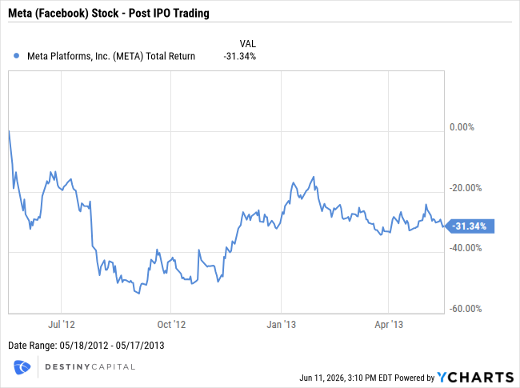
While we haven’t seen underlying market mechanics like this, we’ve certainly seen highly volatile IPOs in the past. For example, Meta (Facebook) IPO’ed in 2012 and was one of the most highly anticipated initial public offerings of its era. The stock was priced at $38 per share and immediately fell below its offering price, losing roughly half its value within the first four months of trading, as you can see in the chart below that illustrates the volatile first year of trading for Meta.
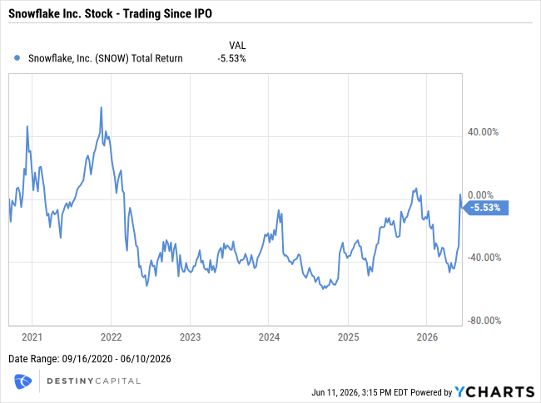
Snowflake was another hot IPO back in 2020. The stock opened in September 2020 at more than double its IPO price and traded as high as $341/share, then began a period of extreme price swings thereafter. As-of the latest pricing data, a buy-and-hold IPO investor in Snowflake stock would still not have reached a breakeven from their initial purchase, as seen in the chart below.
None of this is intended to speak to the viability of SpaceX as a company or an investment, but helps to illustrate just how volatile IPOs can be in early trading, which is why the 12-month ‘seasoning’ requirements are/were in place to begin with at many of the index providers.
On Deck – Althropic, OpenAI and Others
SpaceX is the first mega-cap IPO to be launched under these new index rules, but it certainly won’t be the last. As you’ve likely heard in the financial news media, there is a lot of talk about IPOs for some of the major players in Artificial Intelligence (AI) such as Anthropic and OpenAI. In fact, in early June, both companies filed S-1 paperwork with the SEC signalling their intent to go public. While the timing of each IPO is unknown, many investors speculate that we could see each stock launched prior to year-end of 2026.
That means, for investors who own passive funds that track indexes like the Russell 1000 or Nasdaq-100, they could see these stocks fast-tracked into their portfolios. It’s also very important to note that, for most cap-weighted indexes, the size of the allocation within an index is heavily influenced by float (shares available to trade publicly). So, while the public float remains small for a stock like SpaceX (roughly 4.3% initially), the allocation within an index like the Russell 1000 will remain somewhat small. As insider lockups expire in the months ahead (typically 180 days), we could see the size of the SpaceX allocation within an index increase as public float increases as employees, executives and early investors seek to sell some of their stock. As such, investor exposure to SpaceX (and potentially Anthropic and OpenAI) is likely to be somewhat muted in the first few months post-IPO, so investors don’t need to worry about being over-allocated to a potentially volatile IPO stock.
Our Take
Given my experience as an investor over the years, I tend to take a cautious approach to investing in new IPOs. It can be hard not to get caught up in FOMO (fear of missing out) when a much-hyped IPO launches and immediately moves 10%-30% higher in the days immediately after trading begins. In fact, few companies have captured the imaginations of investors like SpaceX. With reusable rockets, the company has transformed the economics of space launches, it built the world’s largest satellite internet network (Starlink) and is a leader in a handful of emerging technologies.
However, as Uncle Ben said to Peter Parker, “with great power comes great responsibility”, and, as a newly minted publicly traded company, SpaceX and their executives now have a responsibility to add shareholder value. From here on out, every quarterly earnings report will be scrutinized, every word uttered by Elon Musk will be parsed, and every rocket launch will be tracked by dozens of analysts and millions of investors. Any hiccup along the way could be immediately reflected in the stock price and, at some point in the not-too-distant future, potential will have to equate to some kind of payoff for investors.
As I mentioned earlier, I tend to get very excited when innovative new companies come to market. However, before we explicitly advocate for allocating capital to a stock like SpaceX, we’d like to see a bit more seasoning and give the market a little time to digest a few earnings reports and flesh-out an appropriate price. Yes, that could potentially mean missing some upside, but can also save an investor from massive short-term swings during the first few quarters of trading. In the meantime, many investors have the opportunity to gain at least some exposure to stocks like SpaceX and, eventually, Anthropic and OpenAI, through index-tracking exchange traded funds, and that typically is an appropriate allocation for most investors.
Important Monthly Updates
We’ll close this month’s letter with a brief update on several key events and indicators that have been driving markets in recent weeks, including:
Inflation – CPI & PPI
The latest Consumer Price Index (CPI) report for May showed aggregate prices increasing a lofty 4.2% over the past twelve months. This represents the highest Headline CPI reading since April of 2023 and marks the third consecutive month of rising inflation, as seen in the chart below.
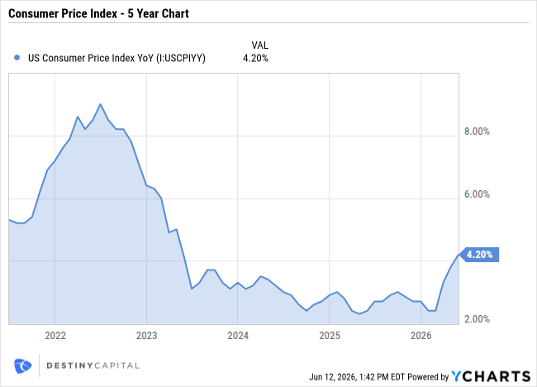
Nearly 60% of the increase in CPI was driven by energy prices alone which have risen 23.5% over the past year.
Meanwhile, the Producer Price Index (PPI) rose to 6.5% year-over-year, marking the highest annual reading since November of 2022. Producer prices were clearly impacted by energy, as well, which included a 23.4% surge in wholesale gasoline prices. Producer prices are important to track because rising input and wholesale costs are typically passed-on to consumers in the months ahead, which could signal continued upward pressure on CPI.
The Iran War
As of this writing, there is little to update regarding the war in Iran. In recent days, the U.S. and Iran have traded strikes, causing trepidation that the current ceasefire could fall apart. The bottom-line is that this conflict adds a tremendous amount of uncertainty, as this war could be resolved in days, weeks, months or even years. It is impossible to predict when a ‘deal’ might be struck, if at all. In the meantime, the Strait of Hormuz remains closed which puts upward pressure on energy prices, which could eventually impact Fed policy related to interest rates, as we’ll review next.
Jobs & Fed Policy
The May jobs report indicated that 172,000 non-farm payrolls were added last month – well above the 85,000 economists expected. Furthermore, we saw upward revisions from prior jobs reports that led to an additional 93,000 jobs added relative to what was initially reported. Typically, a strong jobs report would be lauded as a positive for the U.S. economy. Instead, the S&P 500 and Nasdaq-100 immediately declined -2.4% and -4%, respectively the day the jobs report was released.
While this sounds counterintuitive, the reason is simple. If the labor market remains resilient, then the Federal Reserve may shift its policy priorities to battling inflation. This means that, if inflation remains elevated and prices show signs of becoming entrenched, we could actually see the Fed raise interest rates in the months ahead. Heading into 2026, many investors were anticipating rate cuts throughout the year as the impact from tariffs began to normalize and, ideally, inflation moved closer to the Fed’s 2% target. However, investors weren’t anticipating a war with Iran and the closure of the world’s most vital commodity shipping lane in the Strait of Hormuz.
Now, investors are somewhat split as to whether or not the Fed will raise interest rates in 2026, with 43% of investors predicting that rates will remain unchanged (3.5%-3.75%) while many others are anticipating a 0.25% rate hike (41%) or even a 0.50% rate hike (13%) as seen in the chart below.
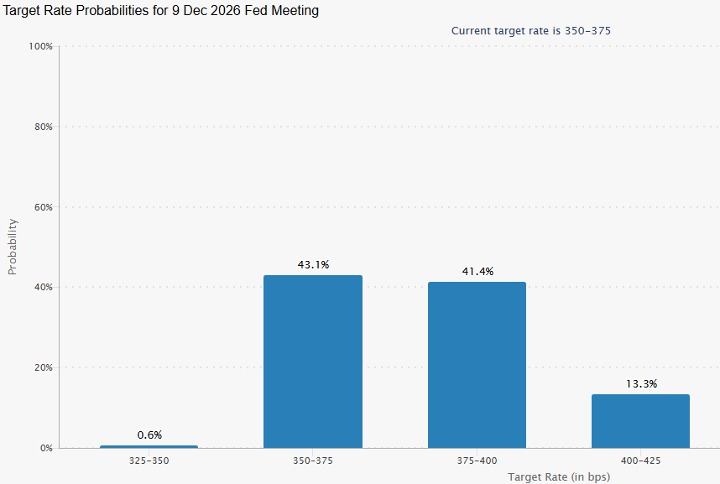
Source: CME Group Fedwatch Tool
Rest assured, we’ll be watching the next Fed meeting very closely on June 17th, particularly with the new Fed Chairman, Kevin Warsh, at the helm. While we don’t anticipate any changes to interest rate policy at the next meeting, it’ll be interesting to parse Warsh’s commentary and see how he intends to navigate pressure from the Trump administration who would like to see the Fed aggressively cut interest rates.
In the meantime, as always, please don’t hesitate to reach out if you have any questions about any of the above, including information about the SpaceX IPO and any exposure, however limited, you might have in your investment portfolio. I would also encourage you to submit questions to our CIO Mailbag here. This is an opportunity for clients and others to ask questions related to markets, the economy, investments, and more. I will either respond to the question directly, or we’ll be sure to cover the questions in an upcoming investor letter or monthly webinar. We’ve certainly been fielding a lot of questions around the SpaceX IPO in recent weeks, so my hope is that this letter was informative.
Important note and disclosure: This article is intended to be informational in nature; it should not be used as the basis for investment decisions. You should seek the advice of an investment professional who understands your particular situation before making any decisions. Investments are subject to risks, including loss of principal. Past returns are not indicative of future results. Advisory services offered through Destiny Capital Corporation, an Investment Adviser registered with the U.S. Securities & Exchange Commission.
2024 YCharts, Inc. All Rights Reserved. YCharts, Inc. (“YCharts’) is not registered with the U.S. Securities and Exchange Commission (or with the securities regulatory authority or body of any state or any other jurisdiction) as an investment adviser, broker-dealer or in any other capacity, and does not purport to provide investment advice or make investment recommendations. This report has been generated using data manually input by the creator of this report combined with data and calculations from YCharts.com and is intended solely to assist you or your investment or other adviser(s) in conducting investment research. You should not construe this report as an offer to buy or sell, as a solicitation of an offer to buy or see, or as a recommendation to buy, sell, hold or trade, any security or other financial instrument. THE IMPORTANT DISCLOSURES FOUND AT THE END OF THIS REPORT (WHICH INCLUDE DEFINITIONS OF CERTAIN TERMS USED IN THIS REPORT) ARE AN INTEGRAL PART OF THIS REPORT AND MUST BE READ IN CONJUNCTION WITH YOUR REVIEW OF THIS REPORT. Disclosure – YCharts
Share this
Stay Ahead with Smart Investments
Learn how to invest wisely and minimize risks to protect your retirement savings.

Achieve Your Retirement Goals
Get personalized advice to meet your retirement goals. Book your call with Destiny Capital now.