CIO Mailbag: What is De-Dollarization and What Does It Mean For My Portfolio?
by Tim Doyle, Chief Investment Officer, CFP®, MBA
Every few meetings, Destiny Capital’s Strategists receive some variation of the same question: “is the U.S. dollar losing its status in the world? Should I be concerned?” It is a fair question, and one that has been addressed – with varying degrees of hysteria – in the financial news media in the past few years. The term that tends to accompany this coverage is de-dollarization – a word that sounds intriguingly ominous and undoubtedly receives many clicks from online viewers. So, in the latest installment of the Destiny Capital CIO Mailbag, I wanted to provide a grounded explanation for what de-dollarization actually is, why it is happening (if at all) and what it may mean for investors. The short answer is: this is a real phenomenon that warrants monitoring, but isn’t an immediate crisis that should cause investors to lose sleep. The longer answer – for which I am famous (or infamous) – follows.
What is De-Dollarization?
De-dollarization broadly refers to the reduction in the utilization of the U.S. dollar as the world’s dominant currency for trade, finance, and official reserves. The dollar has largely occupied this lofty role since the end of World War II when the Bretton Woods Agreement outlined the financial architecture that would govern the post-WWII economy with the U.S. dollar serving as its linchpin. This arrangement has since been extremely advantageous and has allowed the United States to borrow cheaply, price commodities in its own currency, and exercise tremendous geopolitical leverage throughout the global financial system.
As you might infer, de-dollarization is the process by which other nations, institutions and global market participants seek to reduce their dependence on the U.S. dollar which would, theoretically, reduce some of the economic privileges that the United States has been afforded for decades.
What is Driving De-Dollarization?
Geopolitical Tensions & Sanctions
If I were to point to the key catalyst of the concept of de-dollarization in recent years, it would be the U.S. (and allies) freezing roughly $300 billion in Russian central bank assets following the Russian invasion of Ukraine in early 2022. This unprecedented action sent a clear signal to all sovereign nations that hold dollar denominated reserves – those assets can be frozen by the United States under the right conditions as a punitive measure. For countries that have an adversarial relationship with the U.S. – China, Russia, Iran, Venezuela and others – this was a chilling message and incentivized them to reduce reliance on dollar exposure as a hedge against this type of risk.
This accelerated efforts for countries – including those with a non-adversarial relationship with the U.S. like India, Brazil, S. Africa and others – to develop bi-lateral currency swap agreements and local currency settlement arrangements not due to anti-American ideology, but as a hedge against the risk of potential sanctions.
An Evolving Global Economy
The U.S. dollar’s share of global foreign exchange reserves has fallen from nearly 85% in the 1970’s to roughly 57% as-of 2024. While a nearly 30% slide might sound dramatic, context is key and it’s important to note that the Euro (20%) and Japanese Yen (6%) are the next largest reserve currencies, as you can see in the chart below.
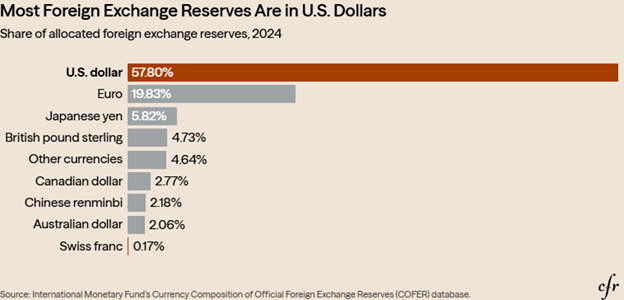
Meanwhile, the Chinese renminbi accounts for only 2% of foreign exchange reserves despite the fact that China represents nearly 20% of the global economy as measured by global GDP. Furthermore, the dollar’s supremacy remains most relevant and stable when it comes to daily foreign exchange trading, cross-border payments and commodity pricing. The underlying message here is that no single challenger has emerged as a viable threat to unseat the dollar’s dominance.
U.S. Fiscal Challenges
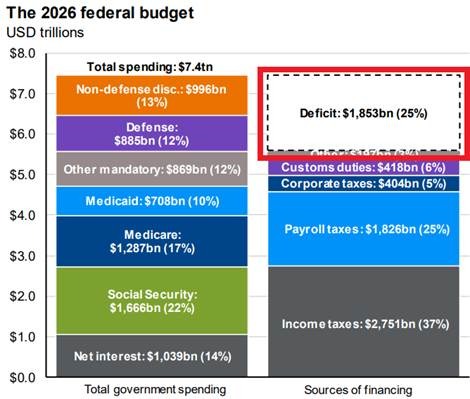
As I’ve written and discussed many times in recent years, the United States is on an untenable path when it comes to federal deficit spending. The U.S. federal government continues to spend more than it generates in revenues, leading to a deficit that is estimated to be (and will likely exceed) $1.9 trillion for the 2026 fiscal year, as you can see highlighted in red in the federal budget chart below.
Source: JP Morgan Asset Management – Guide to the Markets
To fill this deficit, the U.S. must borrow by selling treasury bonds. Subsequently, the U.S. will need to pay interest on these bonds to the governments, organizations, institutions and individuals who purchase them. As interest rates have risen in recent years, so has the annual payments (net interest expense) for outstanding debt. The U.S. now must allocate 14% of its federal budget to debt servicing alone – levels that are approaching the cost of Medicare (17%).
To be clear, foreign investors aren’t fleeing and abandoning the U.S. dollar, but are making more incremental adjustments by holding slightly more euros, gold and other assets as a hedge against the long-term risks associated with continued deficit spending and the overall financial trajectory of the U.S.
What Does This Mean for Long Term Investors?
If history is any guide, reserve currency transitions tend to happen over decades (even generations), not years. If we were to see a gradual shift in the dollar’s dominance, then there could be potential portfolio implications, so we’ll focus on a few asset classes that may serve as a potential hedge against de-dollarization.
International Stocks
When the U.S. dollar declines relative to other currencies, international equities held by U.S. investors receive a currency tailwind that can boost performance on its own. This is known as ‘currency translation’, and is a key reason that international equities have experienced a performance boost in the past 12-18 months as the. U.S. dollar declined sharply in early 2025, as seen in the chart below.
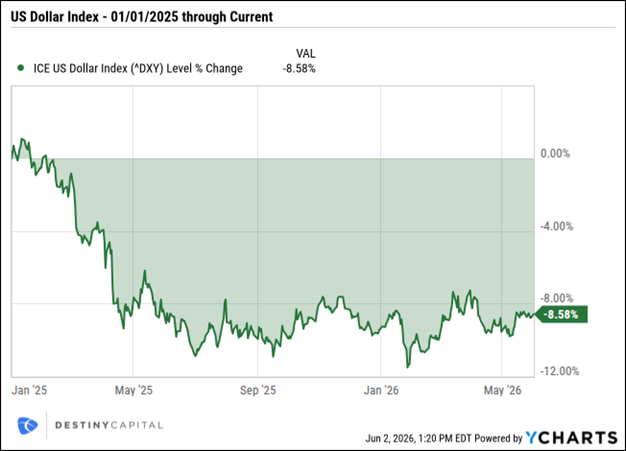
As an example, this decline in the dollar boosted 2025 returns of Eurozone stocks roughly +10% on its own. However, it’s important to note that currency movements are far from predictable and, at Destiny Capital, we tend to place a much greater emphasis on equity fundamentals – particularly earnings growth. When it comes to earnings growth, the S&P 500 (the 500 largest U.S. companies as measured by market cap) reported Q1 2026 earnings growth of a staggering +28.6%. Therefore, it’s important for long term investors not to get caught up in benefiting from short-term currency tailwinds and remain focused on real drivers of shareholder value like earnings growth and other key fundamentals.
Real Assets as a Potential Anchor
Perhaps the most straightforward response to long-term dollar erosion is an allocation to assets that hold value independent of any single currency. Gold is an example of this, as we’ve seen central banks worldwide – including China, India and many others – accelerate their purchases of gold over the past 3-5 years as an additional diversifier. In the case of gold, this increase in demand boosted gold returns to over +130% over the past five years. While that trajectory likely remains unsustainable over the long-term, gold still remains a popular hedge for both central banks and investors across the globe.
Real assets in general – including real estate, commodities, and inflation-protected securities – serve a similar purpose within a portfolio as they are assets of real, tangible value — rather than promises denominated in a currency whose value may erode over time.
Private Credit
This may not be an obvious connection to de-dollarization, but it is worth noting. Private credit is overwhelmingly dollar denominated as U.S.-domiciled direct lending funds extend floating rate loans to middle-market corporations. In a world where dollar-related interest rates remain elevated in order to attract foreign capital, floating rate private credit tends to perform very well. In private credit, performance is anchored in the cash flows of domestic businesses and not market and/or currency whims.
Bitcoin – The Newest Entry in the Conversation
No conversation about de-dollarization would be complete without at least acknowledging Bitcoin as a part of the discussion. In March of 2025, President Trump signed an executive order establishing a U.S. Strategic Bitcoin Reserve, which was largely a symbolic but meaningful acknowledgement that Bitcoin may have a role in sovereign reserve management. Opinions about Bitcoin abound, but proponents argue that Bitcoin’s fixed supply (21 million coins) make it structurally superior as a long-term store of value that remains neutral and decentralized. Furthermore, Bitcoin has received further validation through widespread institutional adoption including the release of spot-price exchange traded funds (ETFs) in early 2024.
While Bitcoin remains somewhat volatile, we tend to view it as a portfolio diversifier (in moderation), a monetary/de-dollarization hedge, and an asset class with the potential for asymmetric upside in the years ahead.
The Bottom Line
De-dollarization is real, it is measurable and is something that we’ll be monitoring over time. However, it is also slow-moving, incomplete, and more of a structural undercurrent rather than an imminent financial earthquake. The U.S. dollar remains, by far, the world’s reserve currency and the dominant medium of global trade as you can see in the chart below.
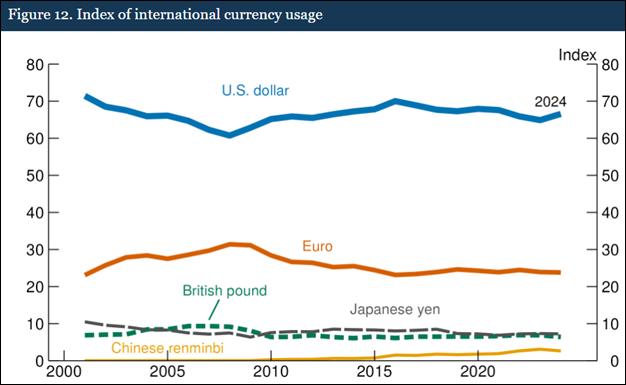
Source: www.federalreserve.gov – The International Role of the U.S. Dollar – 2025 Edition
The U.S. dollar remains the anchor of the strongest capital market in history, and no challenger has the institutional depth, liquidity or geopolitical credibility to unseat the greenback in the near-term. However, this conversation does stress the importance of portfolio diversification and owning assets that serve a variety of purposes within a portfolio simultaneously. As always, this remains a core tenet of investing at Destiny Capital.
Important note and disclosure: This article is intended to be informational in nature; it should not be used as the basis for investment decisions. You should seek the advice of an investment professional who understands your particular situation before making any decisions. Investments are subject to risks, including loss of principal. Past returns are not indicative of future results. Advisory services offered through Destiny Capital Corporation, an Investment Adviser registered with the U.S. Securities & Exchange Commission.
2024 YCharts, Inc. All Rights Reserved. YCharts, Inc. (“YCharts’) is not registered with the U.S. Securities and Exchange Commission (or with the securities regulatory authority or body of any state or any other jurisdiction) as an investment adviser, broker-dealer or in any other capacity, and does not purport to provide investment advice or make investment recommendations. This report has been generated using data manually input by the creator of this report combined with data and calculations from YCharts.com and is intended solely to assist you or your investment or other adviser(s) in conducting investment research. You should not construe this report as an offer to buy or sell, as a solicitation of an offer to buy or see, or as a recommendation to buy, sell, hold or trade, any security or other financial instrument. THE IMPORTANT DISCLOSURES FOUND AT THE END OF THIS REPORT (WHICH INCLUDE DEFINITIONS OF CERTAIN TERMS USED IN THIS REPORT) ARE AN INTEGRAL PART OF THIS REPORT AND MUST BE READ IN CONJUNCTION WITH YOUR REVIEW OF THIS REPORT. Disclosure – YCharts
Share this
Stay Ahead with Smart Investments
Learn how to invest wisely and minimize risks to protect your retirement savings.

Achieve Your Retirement Goals
Get personalized advice to meet your retirement goals. Book your call with Destiny Capital now.