Markets and Economy: Looking Below the Surface
by Tim Doyle, Chief Investment Officer, CFP®, MBA
At the end of July, my wife and I loaded up the family truckster and drove our two boys on an excursion to the finger lakes region of upstate New York. We were extremely fortunate to have access to a cozy cabin that had a deck and a long dock that stood over the crystal-clear waters of Seneca Lake. While winter can be unforgiving in that particular area of New York, the region is stunningly beautiful in the summertime. Our trip was filled with many hours of fishing, swimming, hikes through picturesque gorges, picnics, farm tours, and we even snuck in a wine tasting at one of the area’s many beautiful vineyards.
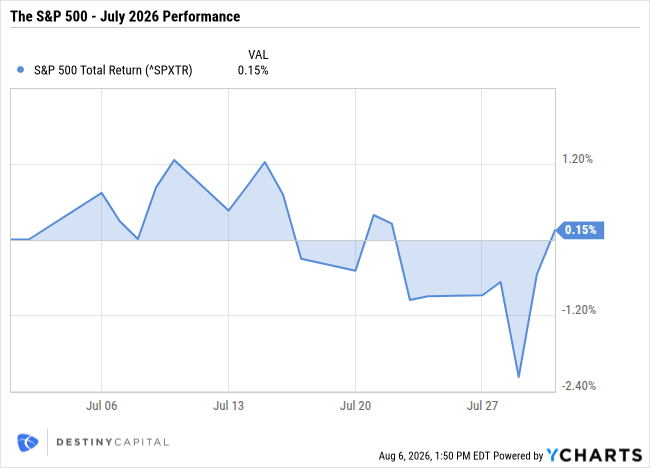
On most days, we’d eat breakfast or lunch outside on the cabin’s deck, and each time we’d be joined by a family of ducks who apparently considered our cabin’s little alcove ‘home’. One day, the lake was particularly gusty, yet the ducks floated motionless atop the water with apparent ease, yet, I knew that truly wasn’t the case. Below the water, I knew that their little webbed feet were paddling with furor just to keep their little flock from being blown to shore, and watching this reminded me of what I had seen happen with the stock market over the month of July. At first glance, July appeared to be a rather ho-hum month with the markets ending the month roughly flat, as you can see in the S&P 500 chart below.
However, if you look a little deeper, you’ll see that there have been plenty of headwinds seeking to push financial markets off track. So, in this month’s letter, we’ll focus on a few of these headwinds including the Fed, inflation, rising US Treasury yields, a sharp selloff in semiconductor stocks, the post-IPO collapse of SpaceX, and more. We’ll begin with a timely update from the Fed, as they just wrapped up their Federal Open Market Committee (FOMC) meeting in late July.
Investors Adjusting to New Fed Leadership
On July 29, the FOMC voted 9 to 3 in favor of keeping the federal funds rate unchanged at its current target range of 3.50% to 3.75%. This vote was notable given that three members – Beth Hammack, Neel Kashkari and Lorie Logan – dissented in favor of raising interest rates by 0.25%. Beyond the three dissenting votes (which is quite rare), investors are adjusting to the communication style of new Fed Chairman, Kevin Warsh, who appears to have a ‘less is more’ mindset when it comes to messaging and overall transparency as evidenced by the stark brevity of his meeting statement released after each FOMC meeting.
Furthermore, I was interested to learn that Warsh declined to personally participate in the Fed’s ‘dot plot’ practice which is where members indicate their personal projection and preference for the fed funds rate in 2026, 2027, 2028 and over the long run. Warsh stated that he did not find individual rate projections helpful to the “current policy conjecture.”
As we all know by now, investors tend to parse every word uttered by whoever sits in the seat of Fed Chair, and there has been some early criticism of Warsh’s ‘less is more’ philosophy. I tend not to view Warsh’s style through a lens of ‘good’ or ‘bad’ – especially given such a short track record. After eight years of a forthcoming, transparent and verbose Jerome Powell, this shift is going to take some getting used to. While I tend to lean heavily in favor of transparency when it comes to anything related to the economy and financial markets, I do believe that investors and economists have grown overly reliant on forward guidance from the Fed when it comes to interest rate, employment and GDP growth data.
Let the Markets Figure It Out
Without overt guidance from the Fed, it will be up to financial markets to ‘figure it out’, and that’s exactly what Warsh appears to want. In fact, we’ve already seen bond markets react to this new Fed dynamic in recent months as evidenced by rising long-term Treasury rates. As you can see in the chart below, the 10 and 30 Year US Treasury Rates have risen sharply over the summer months with the 30-year treasury rate now exceeding 5.2%.
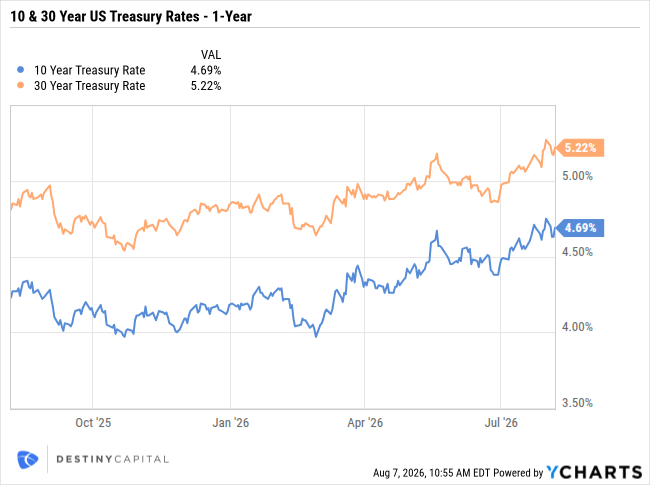
Warsh views rising long-term interest rates as a sign that the system is working and markets are beginning to police the economy. Why? Well, while the Fed controls short-term interest rates, financial markets and supply/demand dynamics dictate longer term rates, and the recent rise in long term rates might indicate two things:
1. Investors are pricing-in higher inflation in the future.
-and-
2. With government spending accelerating and U.S. public debt approaching $40 trillion, investors don’t exactly like what they see and they are demanding greater compensation (higher rates) for the risk involved with buying longer-term U.S. debt.
So, in the eyes of Warsh, the bond market is doing the Fed’s work for them by pushing long-term rates higher which could slow down the economy and lower inflation over time. Remember, the 10-year U.S. Treasury Rate is the benchmark rate for debt of all kinds (auto loans, home loans, student loans, corporate debt, etc) so when rates rise, demand for cars and homes could wane as car payments and mortgages become more expensive. Furthermore, business spending could slow down as it becomes more expensive for businesses to borrow in order to fuel growth. Theoretically, these factors could cause aggregate prices to fall over time and push inflation closer to the Fed’s 2% target.
Clearly, it remains to be seen whether or not Warsh’s philosophy and leadership style will help the Fed achieve its dual mandate of stable prices and full employment, but it’s a sharp contrast to what investors have grown accustomed to with Jerome Powell and will take some getting used-to.
When the Pendulum Swings
When contemplating what we’ve seen with both the SpaceX IPO and and semiconductor stocks over the month of July, two investor quotes come to mind:
“The market is a pendulum that forever swings between unsustainable optimism and unjustified pessimism” – Benjamin Graham
“Reversion to the mean is one of the few iron laws of financial markets” – Jack Bogle
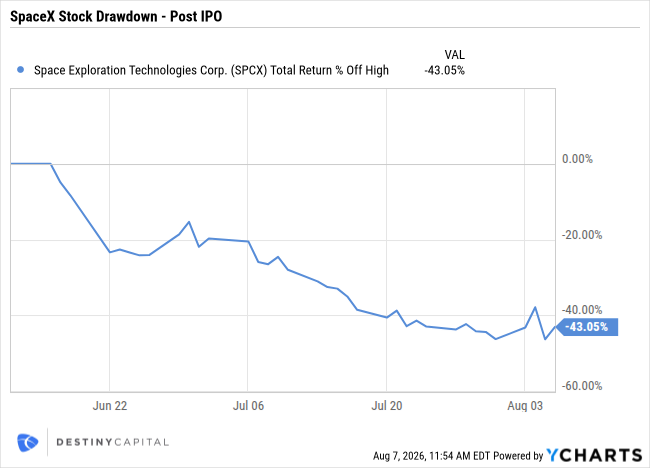
As I’d written about in a previous investor letter, there had been fervent excitement around the SpaceX IPO and retail demand for the stock was extraordinarily strong. This led to what I would consider ‘unsustainable optimism’ given the underlying fundamentals of the company, and we’ve since seen a sharp drawdown with the stock declining roughly -43% from its peak in June.
Furthermore, investors also pumped the brakes on one of the hottest sectors over the past few years – semiconductor stocks. At one point, semiconductor (chipmaker) stocks had soared well-over +150% over the past year as AI infrastructure spending continued to accelerate. However, we saw a sharp reversal with the iShares Semiconductor ETF (SOXX) declining roughly -30% in a few short weeks, as you can see in the chart below.
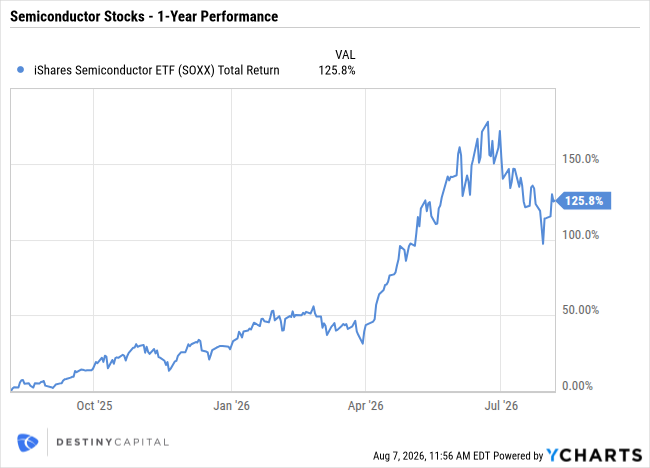
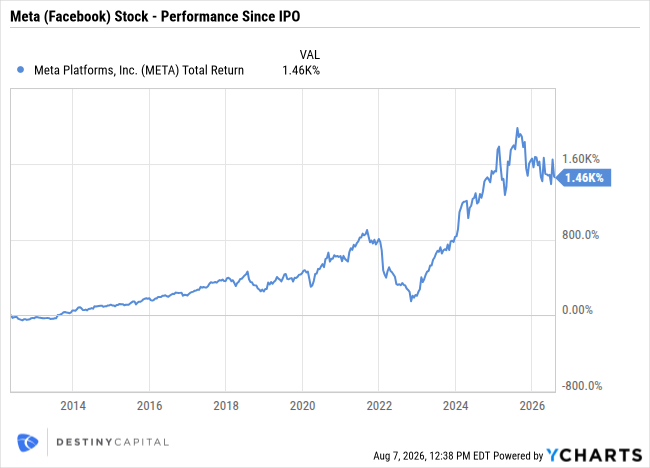
Does this signify the start of a collapse in the AI trade? Hardly. There are simply times when valuations grow a little too high a little too fast, and we see a reversion back to the mean as prices fall to more sustainable levels based on fundamentals and forward guidance. When it comes to the SpaceX IPO, it is not uncommon for high profile IPO’s to experience extreme volatility in the first year or two of trading. Remember, Facebook (Meta) stock declined roughly -50% in its first year of trading, and has since produced a cumulative return of 1,460%, as you can see in the chart below.
Will SpaceX stock experience a similar fate? Obviously, that’s impossible to tell. Any growth projections are pure speculation at this point and the company has yet to turn a profit. However, similar to those who bought Facebook stock in the first few weeks of trading, early SpaceX investors must remain patient and maintain a long-term mindset as company leadership navigates new markets from Starlink to rockets to AI.
Unfortunately, investors are a notoriously impatient lot, which is why we see so many short-term, headline-driven selloffs, so it can be challenging to sit idle when volatility inevitably strikes. For most investors who didn’t participate in the IPO, their exposure to SpaceX stock is likely so small as to be somewhat inconsequential. For example, as of this writing, SpaceX is the 23rd largest stock in the Nasdaq 100 index, which would grant it a 1.04% allocation in a popular exchange traded fund like Invesco QQQ Trust (ticker: QQQ). So, while investors may have some exposure to SpaceX stock, their overall returns likely aren’t being meaningfully impacted by the post-IPO selloff.
Off the Charts Earnings
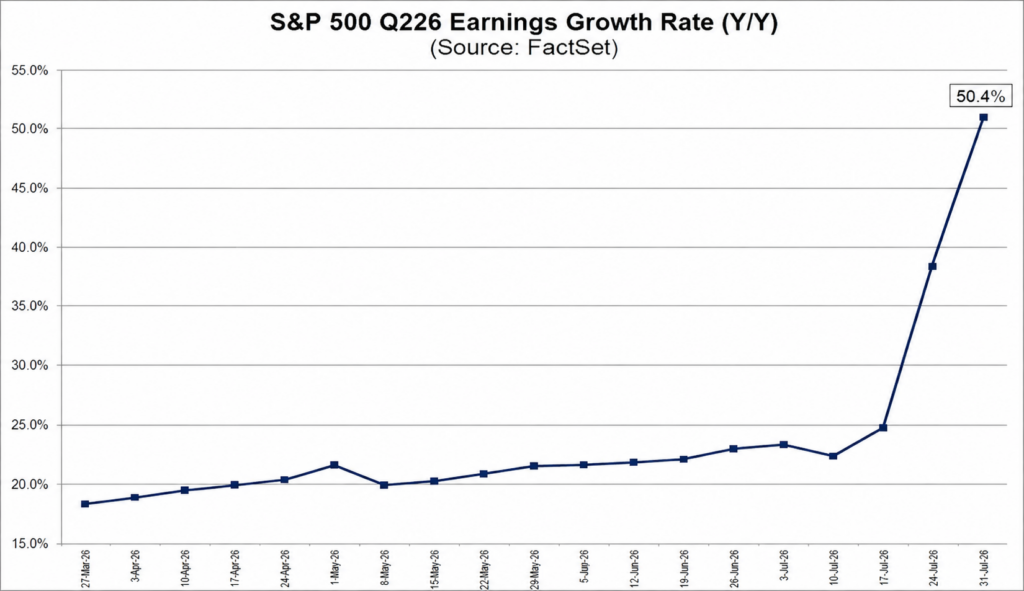
With earnings season winding down, we’ll close with an ‘off the charts’ update on revenue and earnings growth for S&P 500 companies. With 88% of S&P 500 companies reporting, earnings growth has been a staggering +50.4% on a year-over-year basis. As you can see in the chart below, this growth rate is far in excess of anything we’ve seen in recent years – and it’s important to note that earnings growth has been very strong in recent quarters.
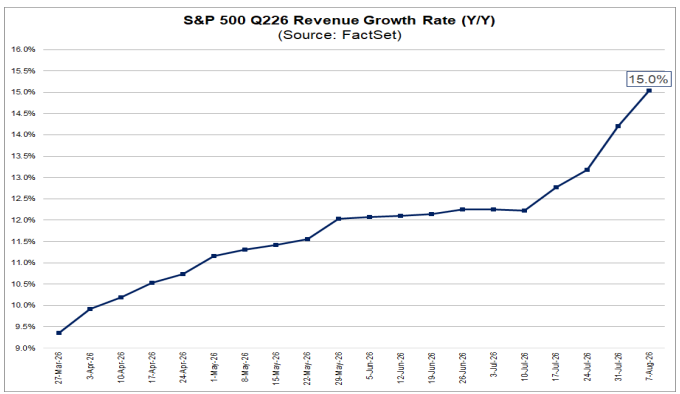
Corporate sales have been strong, as well, with revenue growth surging +15% on a year-over-year basis as you can see in the chart below.
While companies like Amazon and Alphabet have contributed to strong earnings in Q2, it’s important to note that this isn’t a success story that only includes the Magnificent 7 companies. Growth is expanding across the broader market as evidenced by the following:
- 10 of 11 sectors reported year-over-year earnings growth.
- 8 sectors posted double digit earnings growth.
- All 11 sectors generated positive revenue growth.
Furthermore, the outlook for future earnings remains favorable with Q3 and Q4 earnings growth projected to be 27.4% and 25.2%, respectively. In short, U.S. corporations are doing their part to support valuations and push markets higher despite many of the headwinds we’ve outlined in this letter along with uncertainty related to the war with Iran and the subsequent impact on global energy prices.
Important note and disclosure: This article is intended to be informational in nature; it should not be used as the basis for investment decisions. You should seek the advice of an investment professional who understands your particular situation before making any decisions. Investments are subject to risks, including loss of principal. Past returns are not indicative of future results. Advisory services offered through Destiny Capital Corporation, an Investment Adviser registered with the U.S. Securities & Exchange Commission.
2024 YCharts, Inc. All Rights Reserved. YCharts, Inc. (“YCharts’) is not registered with the U.S. Securities and Exchange Commission (or with the securities regulatory authority or body of any state or any other jurisdiction) as an investment adviser, broker-dealer or in any other capacity, and does not purport to provide investment advice or make investment recommendations. This report has been generated using data manually input by the creator of this report combined with data and calculations from YCharts.com and is intended solely to assist you or your investment or other adviser(s) in conducting investment research. You should not construe this report as an offer to buy or sell, as a solicitation of an offer to buy or see, or as a recommendation to buy, sell, hold or trade, any security or other financial instrument. THE IMPORTANT DISCLOSURES FOUND AT THE END OF THIS REPORT (WHICH INCLUDE DEFINITIONS OF CERTAIN TERMS USED IN THIS REPORT) ARE AN INTEGRAL PART OF THIS REPORT AND MUST BE READ IN CONJUNCTION WITH YOUR REVIEW OF THIS REPORT. Disclosure – YCharts
Share this
Stay Ahead with Smart Investments
Learn how to invest wisely and minimize risks to protect your retirement savings.

Achieve Your Retirement Goals
Get personalized advice to meet your retirement goals. Book your call with Destiny Capital now.