Markets and Economy: Rising Interest Rates – What They Mean for Your Borrowing Costs and Portfolio
by Tim Doyle, Chief Investment Officer, CFP®, MBA
In the world of investing, we often use an old adage that’s often attributed to Mark Twain which states, “history doesn’t repeat itself, but it often rhymes.” You see, the ‘plan’ for economists heading into 2026 was that inflation would continue on its downward trajectory towards the Fed’s 2% target, and we’d see short-term interest rates decline to more of a neutral rate around 3.00%. Alas, here we are in the fourth quarter of the year and the Fed just raised interest rates 0.25% and investors expect that interest rates could move even higher from here.
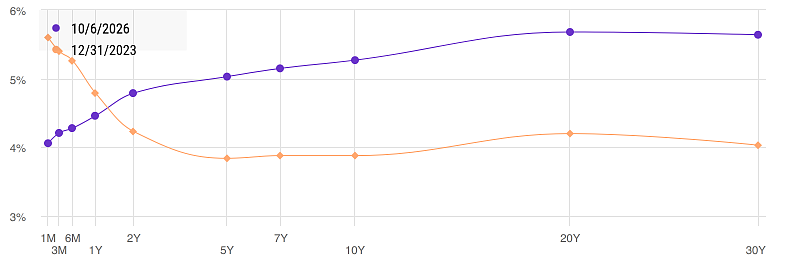
Are we about to see a repeat of 2022 when the Fed raised interest rates at a historically aggressive clip? That’s highly unlikely. Yet, history is once again rhyming and here we are talking once again about a topic that I had hoped was firmly in our rearview mirror as investors – rising interest rates. However, what makes the current rate environment unique is the fact that we are not only seeing higher short-term interest rates, but we have also seen a sharp rise in the 10-year and 30-year U.S. Treasury rates, as you can see in the yield curve chart below that compares short and long-term interest rates both now (purple) and at the end of 2023 (orange).
The Yield Curve – Current (Purple) vs. 12/31/2023 (Orange)
Therefore, I thought now represented an apt time to remind investors of who controls interest rates, what higher rates tend to mean for households, businesses and investor portfolios. So, we’ll take it one piece at a time by first reviewing short-term interest rates.
The Fed Controls the Short End of the Curve
The Federal Reserve controls one interest rate directly – the federal funds rate which is the rate which banks charge each other for overnight loans. After their September meeting, the federal open market committee (FOMC) voted to raise the fed funds target rate a quarter point to 3.75%-4.00%. According to post-meeting statements, this move should support “a timelier return of inflation” back to the Fed’s 2% target.
The logic behind the move is fairly straightforward. When borrowed money costs more, both consumers and businesses tend to spend a bit less. Ideally, this cools demand, which tends to ease the upward pressure on aggregate prices. Fed officials now project that PCE inflation will close the year at 3.7% and don’t expect a return to 2% PCE until 2029. As of the latest FOMC projections, sixteen of eighteen Fed policymakers project at least one more rate hike before year-end.
The impact of the Fed’s decision to hike the fed funds rate was felt almost immediately, as major banks raised their prime rate – the benchmark for most credit cards, home equity lines and many small business loans – to 7%.
The Bond Market Controls the Long End of the Curve
Here’s a piece of the economic puzzle that often surprises people: the Fed does not set the 10-year or 30-year treasury rates. Investors around the globe set those rates every day by deciding what compensation they need to lend their money to the U.S. government for decades. That’s quite a commitment, and It’s become increasingly clear that investors are demanding higher rates (better compensation) as the 10-year yield recently reached 5.35% and the 30-year yield hit 5.70% – their highest levels since 2002. In fact, the 10-year treasury rate is up more than a full percentage point from only a year ago.
Several forces are forcing long-term rates higher at the same time. First and foremost is a topic that we’ve covered at length over the past 3-5 years – the fiscal health of the United States. The federal deficit totaled roughly $2.0 trillion in the first 11 months of fiscal year 2026. As you can see in the chart below, debt held by the public now exceeds the size of the entire U.S. economy.
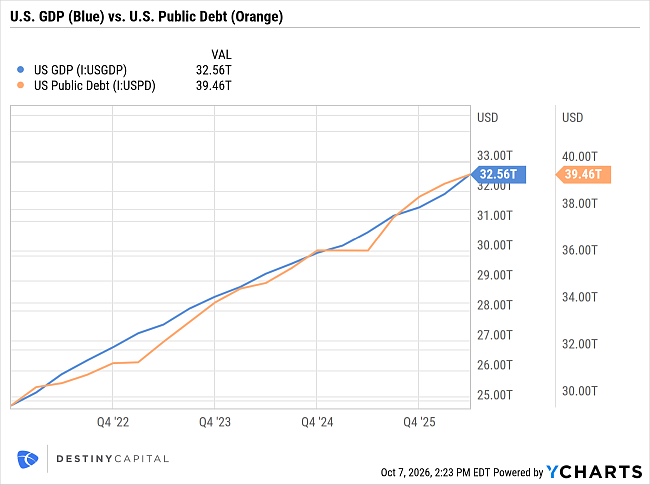
For the first time, the annual interest costs on the national debt has topped $1 trillion dollars. More borrowing means more Treasury bonds to sell, and when supply rises faster than demand, buyers can demand a higher yield as evidenced by a 30-year treasury auction this summer that cleared its highest yield since 2001.
Second, consumer and investor inflation expectations are pushing long term rates higher. A bond investor who is locking in a rate for 30 years needs that rate to outpace inflation over that entire period. According to recent surveys, consumers now expect inflation to hover around 3.4% over the long run – well above the Fed’s 2% target. So, as inflation expectations run higher, then bond investors will demand higher yields so their investment can outpace inflation.
There’s also plenty of competition for capital these days. Large tech companies are borrowing heavily to build data centers and AI infrastructure, issuing roughly $229 billion of debt so far in 2026. That means there are more bonds competing for the same pool of investor dollars, so the treasury yields must be compelling enough to capture the attention of investors who have ample alternatives when allocating capital to fixed income investments like bonds.
Higher Rates Ripple Through the Economy
Long-term Treasury yields represent the foundation that most other borrowing costs are built upon. When the foundation rises, so does everything else that’s stacked upon it.
Business Impact: large, highly-rated companies can often lock in fixed-rate debt for many years. This is because they have ample collateral assets, strong cash flows, and typically represent less of a default risk for lenders. Smaller companies don’t have that same luxury. Interest expense now consumes about 31% of operating earnings for companies in the Russell 2000 small-cap index versus roughly 7% for much larger companies in the S&P 500 index. Furthermore, nearly 30% of small cap debt is floating rate, meaning that as baseline interest rates move higher, so will the rates for floating-rate debt. According to bond giant PIMCO, about $4.3 trillion of corporate bonds come due between 2027 and 2031, which means that refinancing costs for borrowers could skyrocket, which could hurt both profitability and growth prospects as it becomes more expensive to fund expansion.
Household Impact: consumers feel higher rates in nearly every major purchase, including:
Home Purchases: the average 30-year fixed mortgage rate rose to 7.28% on October 1st, up from roughly 6% back in March of 2026.
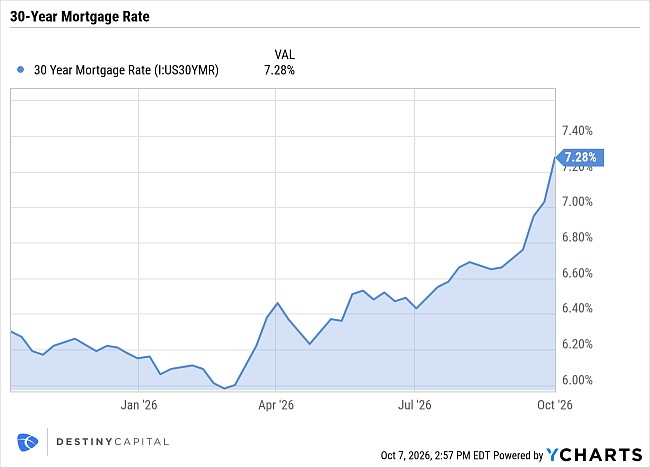
On a $400,000 loan, that equates to a mortgage payment that’s $250 more per month, or $3,000 per year. With home prices already extremely high, higher rates can only worsen the home affordability crisis in the United States.
Car Loans: the average new car loan rate held steady at 7.0% in the third quarter, but the average monthly car payment hit a record $787. As a Certified Financial Planner (CFP) professional, that monthly car payment amount is downright alarming from a personal budgeting perspective.
Student Loans: Federal rates are set each spring based on the 10-year Treasury rate. For the 2026-27 school year, undergraduate loans rates are 6.52%, graduate loans 8.07% and PLUS loans 9.07%. If long-term yields stay near current levels, next year’s rates may be higher still, which can burden borrowers with higher levels of debt upon graduation. With tuition and fees these days, prospective college students may want to do a true cost/benefit analysis prior to enrolling.
Credit Cards: as of May 2026, the average credit card interest rate was a whopping 22%. Given that credit card rates float and are based on the prime rate, it’s likely that credit card rates will move higher from that already elevated 22 percent.
Adding higher borrowing costs on top of elevated inflation seems somewhat unfair for consumers. However, the underlying intent of raising interest rates is to affect consumer behavior to the extent where buyers tap-out and say “I simply can’t afford to buy this.” In theory, only then will demand fall enough for producers to lower prices to levels that will spur renewed consumption of goods and services.
What High Rates Mean for Bond Investors
Bond prices and interest rates move in opposite directions, just like the two opposing ends of a seesaw. When new bonds pay higher yields, existing bonds become less valuable. Think about it – if a newly issued bond pays 5% and you currently hold a 4% bond that you want to unload, you would have to lower the price of your bond enough to attract a buyer who might simply just purchase the new 5% bond. This dynamic – in aggregate – is what we’re seeing across bond markets today. As you can see in the chart below, as interest rates have risen (orange line), bond prices – as measured by the Bloomberg U.S. Aggregate Bond Index – have fallen.
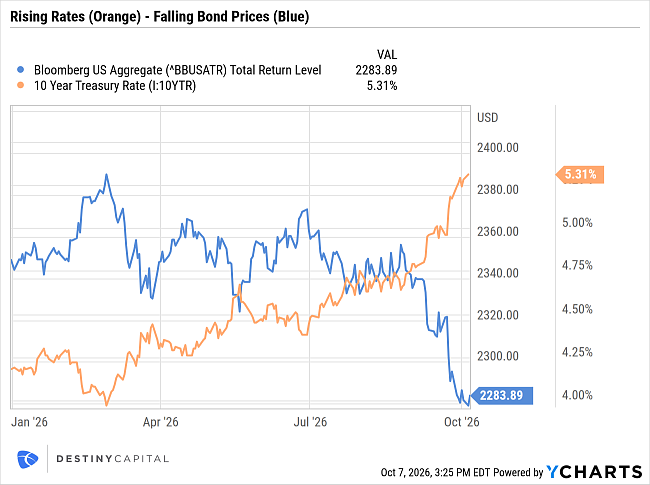
Furthermore, as rates move higher across the long end of yield curve, then longer-term bonds tend to be hit the hardest. At Destiny Capital, we closely track the duration of our fixed income allocations. Generally speaking, duration measures how sensitive a bond is to changes in interest rates. For example, if a bond has a duration of 5 and interest rates rise 1%, you can expect the price of that bond to fall by -5%. The opposite is true should interest rates fall. Regardless, at Destiny Capital, we’ve purposely structured our portfolios to limit the duration of our fixed income allocations. Furthermore, we’re diversified across the spectrum of fixed income instruments – both public and private – to cushion client portfolios from shifts in interest rates.
While rising interest rates may be uncomfortable for bond investors in the short-term, there’s a silver lining. As interest rates move higher, so does the compensation received by investors in the form of higher yields. This can be seen in the rates paid for basic money market instruments or corporate bonds, to name just a few. This period of rising rates is a reset, of sorts, for savers and fixed income investors in ways that will pay off (literally) over time.
As always, as portfolio managers here at Destiny Capital, we continue to diversify thoughtfully across client portfolios to help our clients navigate challenging market conditions in the near term so they may maintain focus on long-term goals and wealth accumulation. If you have any questions about interest rates and/or your fixed income allocations, please don’t hesitate to reach out to your Strategist or Planner.
Important note and disclosure: This article is intended to be informational in nature; it should not be used as the basis for investment decisions. You should seek the advice of an investment professional who understands your particular situation before making any decisions. Investments are subject to risks, including loss of principal. Past returns are not indicative of future results. Advisory services offered through Destiny Capital Corporation, an Investment Adviser registered with the U.S. Securities & Exchange Commission.
2024 YCharts, Inc. All Rights Reserved. YCharts, Inc. (“YCharts’) is not registered with the U.S. Securities and Exchange Commission (or with the securities regulatory authority or body of any state or any other jurisdiction) as an investment adviser, broker-dealer or in any other capacity, and does not purport to provide investment advice or make investment recommendations. This report has been generated using data manually input by the creator of this report combined with data and calculations from YCharts.com and is intended solely to assist you or your investment or other adviser(s) in conducting investment research. You should not construe this report as an offer to buy or sell, as a solicitation of an offer to buy or see, or as a recommendation to buy, sell, hold or trade, any security or other financial instrument. THE IMPORTANT DISCLOSURES FOUND AT THE END OF THIS REPORT (WHICH INCLUDE DEFINITIONS OF CERTAIN TERMS USED IN THIS REPORT) ARE AN INTEGRAL PART OF THIS REPORT AND MUST BE READ IN CONJUNCTION WITH YOUR REVIEW OF THIS REPORT. Disclosure – YCharts
For informational purposes only. This content is not tax, legal, or investment advice. Consult a qualified tax professional who understands your situation before making decisions.
Individuals showing a CFP® designation hold an active CERTIFIED FINANCIAL PLANNER™ certification. To earn the CFP® designation, the individual had to complete an approved educational program, pass a rigorous examination and meet stringent experience requirements. Designation holders also adhere to a professional Code of Ethics and fulfill annual continuing education requirements to remain aware of current planning strategies and financial trends.
Share this
Stay Ahead with Smart Investments
Learn how to invest wisely and minimize risks to protect your retirement savings.

Achieve Your Retirement Goals
Get personalized advice to meet your retirement goals. Book your call with Destiny Capital now.