CIO Mailbag: Direct Indexing – Owning the Index, One Stock at a Time
by Tim Doyle, Chief Investment Officer, CFP®, MBA
Question: I’ve been hearing more about an investing strategy called ‘direct indexing’. What is it and is direct indexing a strategy I should consider?
Answer: When I contemplate the answer to a question like this, I start to realize that I’ve been in this industry for a very long time and I’ve grown far older than I’d care to admit. I say this because of the pace of innovation I’ve witnessed over the years across the entire financial services industry with direct indexing serving as a prime example of such innovation.
You see, when I first started in this industry, advisors took trade orders from clients over a land-line phone, then manually filled out what we called a ‘trade ticket’ that outlined the details of the trade. The advisor or a member of his/her staff would then call their respective ‘trade desk’ to communicate the order to “buy 100 shares of AT&T stock at the market”, and the trader would subsequently execute the order. Sound efficient? Not so much.
Fast forward to today where an advisor can purchase individual shares representing an entire index and efficiently and effectively manage those shares on behalf of their clients while taking advantage of any tax loss harvesting opportunities that might exist each day. This is done courtesy of an exciting investing innovation called ‘direct indexing’.
What Direct Indexing actually is
In recent decades, investors seeking to efficiently allocate capital into a diversified portfolio typically had two primary choices: mutual funds and exchange traded funds (ETFs). Through each of these investment vehicles, an investor could purchase a single fund that may provide them with exposure to dozens or even hundreds of individual securities.
Recently, a different approach has become increasingly accessible to individual investors, and that approach is called ‘direct indexing’. Through direct indexing, an investor essentially ‘unboxes’ an index and owns each individual stock that makes up that index. Let’s use a common index like the S&P 500 as an example.
Typically, if an investor wanted exposure to stocks in the S&P 500 index, they might buy one of the many popular S&P 500 exchange traded funds (ETFs) from one of the many providers like Vanguard, iShares, SPDR, and more. Through this arrangement, the ETF owns each of the underlying stocks of the S&P 500 index and the investor subsequently owns a small slice of the exchange traded fund. This structure looks something like this:
Traditional Index ETF Investing:
Investor -> ETF -> Individual S&P 500 Stocks
Conversely, if an investor were to employ a direct indexing strategy with the S&P 500 as the target index, the investor would proportionally purchase all 500 stocks that make up the S&P 500 index. That structure would look a little something like this:
Direct Index Investing:
Investor -> Individual S&P 500 Stocks
At first glance, that certainly sounds like an inefficient and unnecessarily complicated way to accomplish the same investment objective. However, modern portfolio management innovations allow managers to overcome that complexity while unlocking opportunities that aren’t available when all those stocks are packaged inside a single fund, and that opportunity is what’s called tax-loss harvesting.
Unlocking Tax Management Opportunities
Consider something that may not be apparent at first glance: in any given year, the S&P 500 index might finish a year up +10%, yet many of the 500 individual stocks within the index may have declined (some significantly) during that same time period. An investor who owns an S&P 500 ETF only sees that single position inside of their account. If the ETF itself has appreciated, there isn’t a loss available to harvest within the portfolio – even though numerous companies inside the ETF may have declined substantially.
A direct-indexing portfolio is different. Because the investor owns individual stocks and not just a single fund, some of those stocks may have gains while others have losses. Strategically taking advantage of the positions with losses could potentially create opportunities to improve the portfolio’s tax efficiency.
For example, let’s imagine that a stock within the direct index portfolio was purchased at $20,000 and subsequently declined to $15,000. The DI portfolio could sell the stock, realize a $5,000 capital loss, then immediately purchase another investment intended to maintain a similar industry/sector exposure without triggering wash-sale rules.
That $5,000 realized loss may then be available to offset capital gains elsewhere in the investors portfolio. Ultimately, the portfolio remains fully invested, but the investor has potentially created a valuable tax asset.
This process of strategically realizing losses in order to potentially offset capital gains is known as tax loss harvesting. Tax loss harvesting isn’t exactly unique to direct indexing, as investors have harvested losses using stocks, mutual funds, and ETFs for many years.
However, what makes direct indexing different is the number of potential harvesting opportunities across the portfolio. An investor holding just one S&P 500 ETF has one position available for harvesting. A direct index portfolio may have hundreds of individual stocks that could be utilized for tax loss harvesting purposes, and loss harvesting screens are typically conducted throughout each and every trading day.
What is “Tax Alpha”?
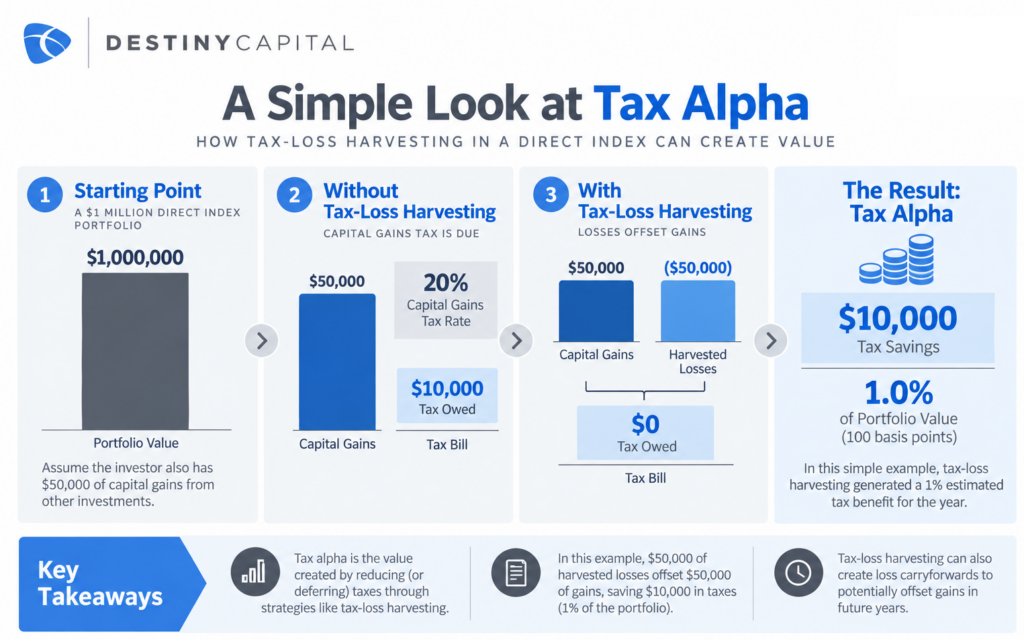
Another term investors may hear that is often associated with direct indexing is tax alpha. Traditional ‘investment’ alpha references the outperformance of a fund relative to its underlying benchmark. Tax alpha is quite different, and generally references the potential improvement in an investor’s after-tax outcome resulting from tax management strategies like tax loss harvesting.
For example, imagine that two portfolios each generate a 10% investment return before taxes. If tax management strategies allow one investor to retain more of that return after-taxes, then the difference can be thought of as ‘tax alpha’. The visual below helps to illustrate the concept of tax alpha.
Introducing Investor Personalization
Another very interesting innovation in the world of direct indexing is that of investor personalization of the direct indexing strategy. Through personalization of an index, an investor could choose to omit certain companies or even entire industries or sectors from their portfolio. An investor may also screen investments based on faith-based preferences, environmental concerns, certain revenue sources (i.e. tobacco producers), and much more. This can help investors align their investing strategy with their personal values.
As a word of caution, it should also be noted that the more an index is personalized and altered, the more the performance may deviate from the underlying index. This performance deviation is known as ‘tracking error’, and this is an important concept to be aware of because if a portfolio is intended to be invested in the S&P 500, then returns should mimic the S&P 500 as closely as possible.
Ideally, an investor does not want to see any negative performance surprises where, for example, the S&P 500 index is up +10% in a given year while their S&P 500 direct index portfolio is up only +6%. Therefore, portfolio managers monitor tracking error very closely and weigh tax loss harvesting opportunities along with the potential repercussions when it comes to tracking error and the performance of the direct index itself. A well-designed direct-indexing strategy, therefore, isn’t simply trying to harvest every possible loss. It is attempting to balance tax efficiency with maintaining the intended investment exposure.
Ultimately, the overall objective of direct indexing is to provide index-like market exposure while creating opportunities to manage taxes more efficiently. It’s also important to stress that harvested losses aren’t a ‘use it or lose it’ scenario. Losses can accumulate and potentially carry over from one year to the next. I assure you, as a portfolio manager for many long-term clients with significant capital gains who are in the distribution phase of their financial journey, having harvested losses that can offset capital gains in any given year is extremely valuable from a tax planning perspective.
At Destiny Capital, investment decisions are evaluated within the context of each client’s broader financial plan—including risk tolerance, taxes, cash-flow needs, charitable goals and long-term objectives. So, if you have any additional questions or wish to understand whether direct indexing could impact the tax efficiency of your portfolio, we encourage you to speak with your Destiny Capital Strategist and/or Coordinator to learn more.
Important note and disclosure: This article is intended to be informational in nature; it should not be used as the basis for investment decisions. You should seek the advice of an investment professional who understands your particular situation before making any decisions. Investments are subject to risks, including loss of principal. Past returns are not indicative of future results. Advisory services offered through Destiny Capital Corporation, an Investment Adviser registered with the U.S. Securities & Exchange Commission.
2024 YCharts, Inc. All Rights Reserved. YCharts, Inc. (“YCharts’) is not registered with the U.S. Securities and Exchange Commission (or with the securities regulatory authority or body of any state or any other jurisdiction) as an investment adviser, broker-dealer or in any other capacity, and does not purport to provide investment advice or make investment recommendations. This report has been generated using data manually input by the creator of this report combined with data and calculations from YCharts.com and is intended solely to assist you or your investment or other adviser(s) in conducting investment research. You should not construe this report as an offer to buy or sell, as a solicitation of an offer to buy or see, or as a recommendation to buy, sell, hold or trade, any security or other financial instrument. THE IMPORTANT DISCLOSURES FOUND AT THE END OF THIS REPORT (WHICH INCLUDE DEFINITIONS OF CERTAIN TERMS USED IN THIS REPORT) ARE AN INTEGRAL PART OF THIS REPORT AND MUST BE READ IN CONJUNCTION WITH YOUR REVIEW OF THIS REPORT. Disclosure – YCharts
Individuals showing a CFP® designation hold an active CERTIFIED FINANCIAL PLANNER™ certification. To earn the CFP® designation, the individual had to complete an approved educational program, pass a rigorous examination and meet stringent experience requirements. Designation holders also adhere to a professional Code of Ethics and fulfill annual continuing education requirements to remain aware of current planning strategies and financial trends.
Share this
Stay Ahead with Smart Investments
Learn how to invest wisely and minimize risks to protect your retirement savings.

Achieve Your Retirement Goals
Get personalized advice to meet your retirement goals. Book your call with Destiny Capital now.