Markets and Economy: Midterm Election Rapid Fire Reaction
by Tim Doyle, Chief Investment Officer, CFP®, MBA
Throughout my lifetime, I’ve always been a bit of a political wonk – someone who’s always been fascinated by the inner workings of the Federal government and the results of key elections. Admittedly, following politics has grown a bit more exhausting over the past decade-plus as political discourse has grown more and more contentious. Still, as usual, I found myself glued to election coverage on Tuesday, November 3rd as polls closed across the country and results started trickling in.
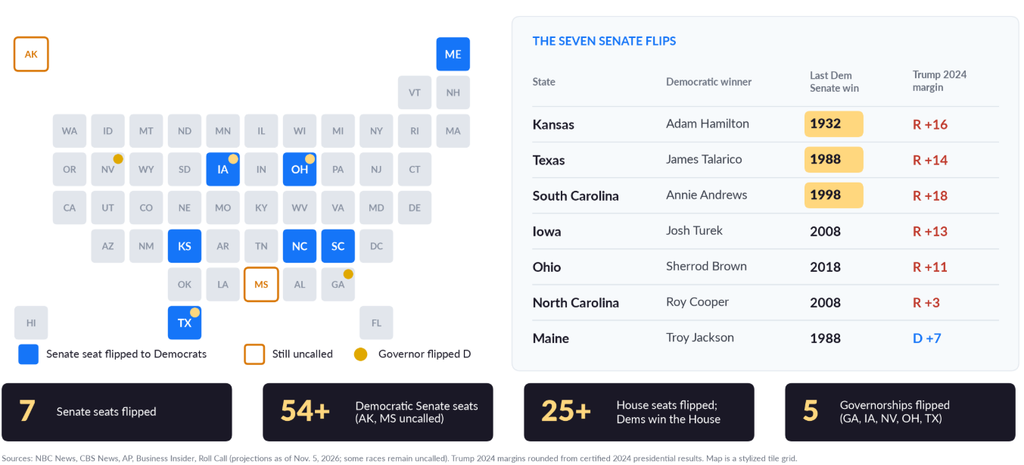
Heading into election day, many polls and prediction markets had Democrats positioned with slight leads in key swing states. When the smoke cleared and votes were finally tallied on election Tuesday, Democrats held 54 Senate seats – a net gain of seven with races in Mississippi and Alaska yet to be called. In the House, Democrats held about 237 seats – a gain of roughly 28 with dozens of races still being counted. Democratic victories didn’t stop at the House and Senate, with several governorships flipped, including in Republican strongholds like Texas. The chart below helps to illustrate the decisive election result, particularly in swing states where President Trump won by wide margins in 2024.
The Midterm Election – By the Numbers
The new Congress will be seated on January 3, 2027. From then until the end of President Trump’s term in office, Washington will operate under a divided government with a Republican White House and Democratic Congress. Remember, the President retains veto power, and overriding a veto takes a two-thirds vote in each chamber, or 67 senators and 290 representatives. Neither party is close to a two-thirds majority on its own.
What does this mean? Well, it means that there is likely a higher probability of political stalemates than the likelihood of major legislation getting passed through the end of President Trump’s term.
How did the markets react to this election result? Well, it depends on which day you checked the stock ticker. On the day of the election, the initial reaction was that of trepidation as U.S. stock futures fell as much as 2% overnight on Tuesday as the results were compiled and it became apparent that Democrats would be taking over both chambers. However, by Wednesday morning, sentiment had shifted and the Dow Jones Industrial Average rose around 3% while the S&P 500 gained roughly 1.6%. By Thursday, we saw a classic whipsaw as markets once again showed signs of hesitation with the S&P 500, DJIA, and Nasdaq selling-off sharply. Clearly, markets are attempting to gain their footing, particularly as it relates to two key themes that seem to be dominating the minds of investors as we head into a world of divided government.
The Iran War, Oil & Inflation
The war that began with U.S. and Israeli strikes on Iran on February 28th has been the dominant story driving the stock market in 2026. Disruption in the Strait of Hormuz – which carried nearly one-fifth of the world’s oil supply before the conflict began – helped to push oil prices from $61 per barrel to nearly $117 per barrel towards the end of October, as you can see in the chart below.
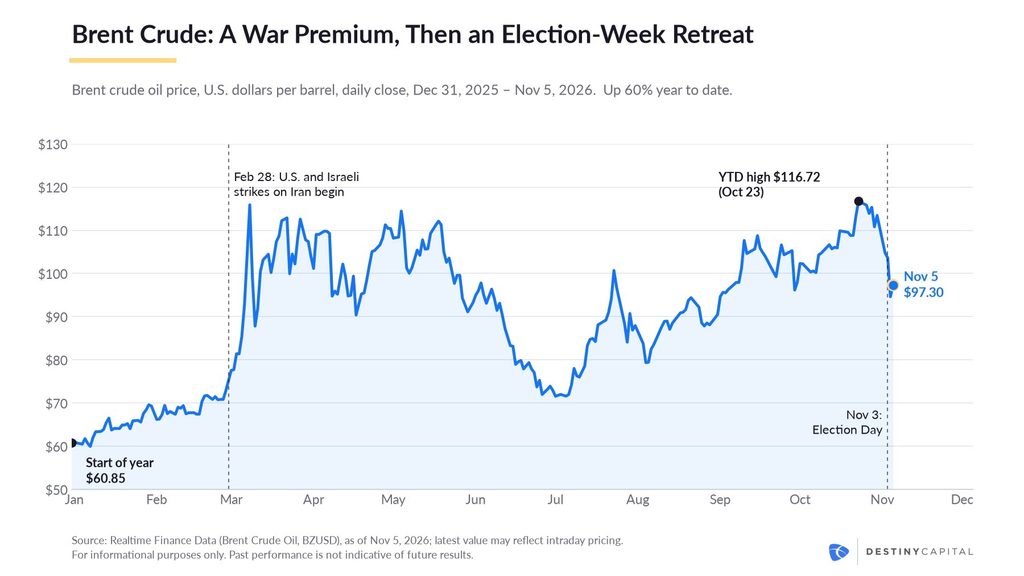
On Wednesday after the election, Brent crude prices fell nearly 9% to below $95 – its lowest level in roughly two months. The reason for the decline wasn’t due to the election result alone, but also the post-election social media messaging from Vice President JD Vance. In his social media post, Vance largely attributed the political losses to the Iran war and voters who are anxious to ‘end the war’. Markets interpreted Vance’s statements, along with a Democratic Congress, as significantly lowering the odds of a major re-escalation of the conflict. That’s far from a certain outcome, however.
Remember, the president directs foreign policy and remains the Commander in Chief of the U.S. Armed Forces. Congress retains the ‘power of the purse’ (aka control over money). Beginning in January, new funding for the conflict in Iran would require approval from both chambers, and lawmakers could attach restrictions to key defense bills that could hasten the end of the war.
While Democrats maintain some leverage in this scenario, it’s important to note that change tends not to happen overnight. That’s why we’d caution against assuming that higher energy prices are soon to be a thing of the past. Throughout his presidency, Donald Trump has been anything but predictable, and economists like Mike Bell of RBC note that there’s a risk that the war could re-escalate now that the election has passed. Clearly, the war in Iran continues to be the dominant source of economic uncertainty, and investors will be watching closely to see what Democrats have planned and how President Trump may react to operating under split government.
AI, Data Centers & Chipmakers
While the Iran war and affordability were key areas of focus for voters during the midterm elections, it’s important for investors to realize that AI was on the ballot, as well. When it came to data centers, voters supported restrictions and/or rejected pro-development proposals in all but one of 41 local ballot measures across 10 states. In Texas – which holds an estimated 27% of planned US data center capacity – Governor Abbott was unseated by a candidate who ran on supporting a moratorium on new data center projects in the state. The concerns around AI and data centers are many, with much of the immediate focus on higher electricity prices across the U.S.
Since the election, the market’s reaction to the potential for enhanced data center regulation has been somewhat split. Some of the larger, cash-rich companies (aka the AI hyperscalers) saw their stock prices rise while companies whose growth depends on data center construction (ie – data center operators, power producers, chipmakers, etc) fell precipitously.
Why are some companies tethered to AI expansion seeing their share prices surge while others drop sharply at the same time? Well, think of AI in terms of a gold rush. If the pace of gold mining slows due to restrictions, then the companies who sell the picks, shovels and other mining equipment will feel the pinch first. The largest miners who are sitting on enormous cash piles may actually benefit by spending a bit less and facing fewer new competitors.
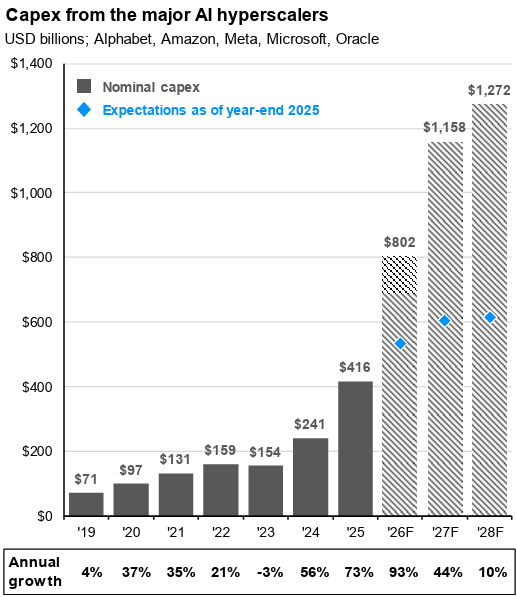
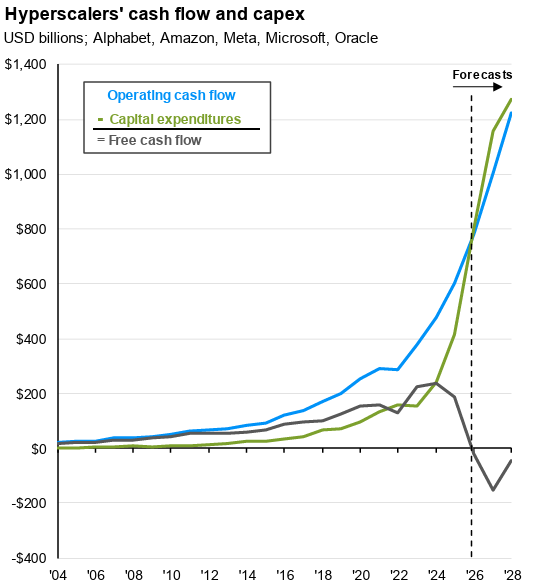
In fact, AI buildout and data center spending has been an area of significant concern for investors in 2026. As you can see in the chart below, the combined capital expenditures (capex) from major AI hyperscalers like Alphabet, Amazon, Meta, Microsoft and Oracle are expected to surpass $1 trillion in 2027. Investors are concerned about if and when this massive spending will pay off in the form of expanding revenues, growing profits and widening profit margins.
This unprecedented spending, in turn, has dwindled the free cash flows for these corporations as you can see in the chart below where capital expenditures are represented by the green line while operating cash flows are represented by the blue line. As you can see, forecasts suggest that capital expenditures will outpace operating cash flows for these corporations in 2026 and beyond. This means that free cash flows for the hyperscalers may be in negative territory in the years to come.
Why are strong free cash flows important to investors? Well, first of all, free cash flows are what reward shareholders in the form of dividends, stock buybacks and/or debt paydown. Free cash flows also drive fundamental valuations as, in theory, a company is worth the present value of all of the cash it will generate in the future. This is the logic that underlies the popular discounted cash flow valuation model. Free cash flows also fund growth and expansion without requiring outside help with financing through the issuance of new stock or taking on expensive debt.
So, long story short, some investors are cheering the fact that the hyperscalers may not be able to spend as freely on AI buildout as predicted, and this could have a positive impact on free cash flows in the quarters ahead.
Beyond data center restrictions at the state and local level, we are also likely to see more of a focus on regulation of AI in general. I, along with many leaders in AI, welcome additional oversight into this new technology as AI’s capabilities are far too consequential to go completely unchecked.
Throughout most of my career, the post-election rush to reposition portfolios has been one of the more reliable ways for investors to hurt themselves. This isn’t because elections don’t matter – it’s because changes in policy tend to move at a snail’s pace in Washington D.C. Any near-term movements in financial markets due to an election result are pure speculation, nothing more.
Still, in the days and weeks ahead, we’ll be watching closely to see if there is any shift in the President’s posture around the Iran war. We will also see our first glimpse into this new political dynamic as Congress faces its next funding hurdle on December 11th. By December 11th, Congress must pass a full-year spending bill or another stopgap similar to the one that was signed in September of 2026. Regardless, it will be fascinating to see how Democrats position their priorities around spending now that the pendulum of power has shifted in their favor in the house and senate.
As always, we’ll continue separating the headlines from what actually matters for investor portfolios, and we’ll share our thoughts as the picture comes into clearer focus. In the meantime, the best response to political change is usually the same one that has served long-term investors well for decades: stay diversified, stay disciplined, and remain patient.
Important note and disclosure: This article is intended to be informational in nature; it should not be used as the basis for investment decisions. You should seek the advice of an investment professional who understands your particular situation before making any decisions. Investments are subject to risks, including loss of principal. Past returns are not indicative of future results. Advisory services offered through Destiny Capital Corporation, an Investment Adviser registered with the U.S. Securities & Exchange Commission.
2024 YCharts, Inc. All Rights Reserved. YCharts, Inc. (“YCharts’) is not registered with the U.S. Securities and Exchange Commission (or with the securities regulatory authority or body of any state or any other jurisdiction) as an investment adviser, broker-dealer or in any other capacity, and does not purport to provide investment advice or make investment recommendations. This report has been generated using data manually input by the creator of this report combined with data and calculations from YCharts.com and is intended solely to assist you or your investment or other adviser(s) in conducting investment research. You should not construe this report as an offer to buy or sell, as a solicitation of an offer to buy or see, or as a recommendation to buy, sell, hold or trade, any security or other financial instrument. THE IMPORTANT DISCLOSURES FOUND AT THE END OF THIS REPORT (WHICH INCLUDE DEFINITIONS OF CERTAIN TERMS USED IN THIS REPORT) ARE AN INTEGRAL PART OF THIS REPORT AND MUST BE READ IN CONJUNCTION WITH YOUR REVIEW OF THIS REPORT. Disclosure – YCharts
Share this
Stay Ahead with Smart Investments
Learn how to invest wisely and minimize risks to protect your retirement savings.

Achieve Your Retirement Goals
Get personalized advice to meet your retirement goals. Book your call with Destiny Capital now.