Markets and Economy: From Fuel to Fertilizer – Navigating Persistent Change
by Tim Doyle, Chief Investment Officer, CFP®, MBA
A few days ago, I arrived home from the airport after a brief business trip and immediately marched right back out the door to take my youngest son to his first ever tee ball practice at our local elementary school. As I watched the team of girls and boys, I couldn’t help but chuckle as they attempted to coordinate their little bodies into throwing a ball or swinging a bat for the first time (often spinning in a full 360 degree turn).
At one point, my son lined up next to a batting tee for some hitting practice so, like most parents, I pulled out my phone and snapped a few pictures. As I scrolled through the photos, I had an intense feeling of deja vu and immediately thought back to several years prior when my oldest son was taking his first practice swings on the very same field. That moment felt like it happened six months prior, yet that ‘little’ boy is now nearly nine years old and stands almost up to my chin. With children, as I’m sure many of you know, change not only happens quickly, but the magnitude of the change can often be extreme.
In recent years, it seems like the same can be said when it comes to change across many facets of society – some trivial, some not. For example, in the realm of college sports, athletes are now paid and conference realignment has significantly shifted the competitive collegiate landscape. Social media has changed the way we view and consume content. The emergence of Bitcoin has introduced a new asset class while blockchain technology may serve as an alternative to finance reliant on traditional intermediaries. As I wrote about in my latest CIO Mailbag, the evolution of AI could impact the labor market and change the way we work in the months and years ahead. This time last year, the U.S. introduced new tariff policies that completely altered the landscape of global trade.
Then, in the first quarter of 2026 alone, U.S. forces captured and imprisoned President Nicolas Maduro of Venezuela, the U.S. Supreme Court ruled that the Trump Administration’s aforementioned tariffs were unconstitutional, and the U.S. is now engaged in a war with Iran that has effectively shut off 20% of the world’s oil supply. Heck, even major league baseball instituted a pitch clock several years ago and implemented the new automated balls and strikes (ABS) challenge system this season! Change is everywhere we look.
At Destiny Capital, one of our firm’s core values is ‘Adaptability’. Being adaptive is vital given the pace of change we see not only across our industry, but across the economy overall. For many, however, the recent pace of change can be unsettling, and can cause an individual to become reactive, and we’ve seen this dynamic in financial markets over the past few months. You can see this in the chart below that shows wild swings in the trajectory of the S&P 500 since the beginning of the year as rapid change has led to elevated uncertainty.
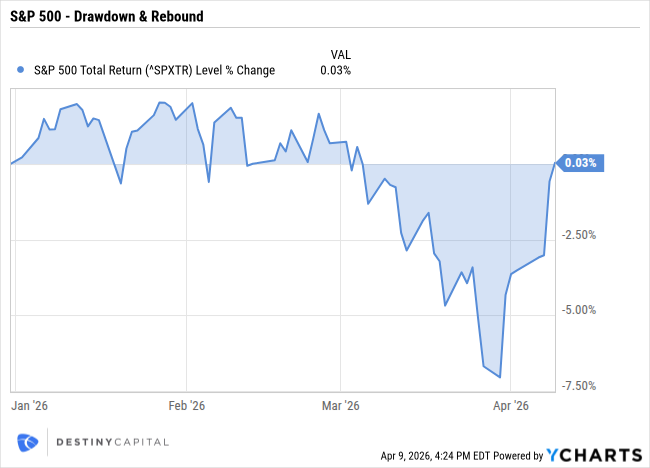
The stock market has been extremely reactive to headline news, particularly as it relates to the war in Iran. As a result, markets have experienced sharp pullbacks, followed in recent days by notable rallies driven by headlines around ceasefires and negotiations. The truth is not much has changed in recent weeks, and markets are moving on mere speculation, not fact. The bottom line is that the Strait of Hormuz remains closed, as you can see in the chart below, and this has effectively shut off 20% of the global oil supply.
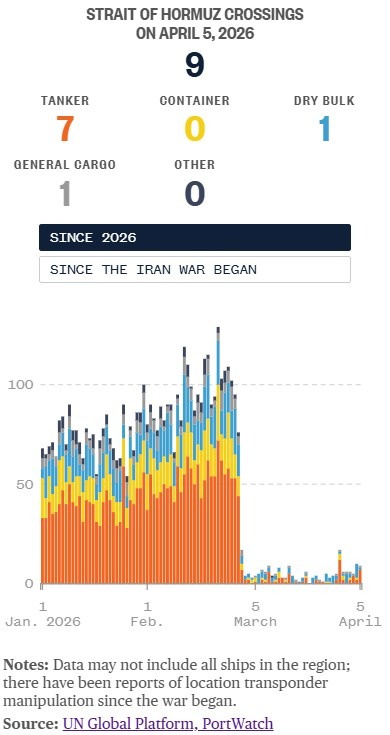
In my investor letter last month, I reviewed the impact this closure has had on both oil prices and prices at the pump. Little has changed in that regard with crude oil prices hovering between $95 and $118 per barrel while AAA reports that the national average for regular unleaded gasoline has surged to $4.15 per gallon.
However, in recent weeks, additional concerns have emerged due to the closure of the Strait of Hormuz, and these concerns deal with the disruption to the global fertilizer supply. Fertilizer requires energy-intensive production, and much of the world’s fertilizer supply is produced in the Middle East, with roughly one-third of global fertilizer trade typically passing through the Strait of Hormuz. Therefore, the increasingly lengthy closure has sent fertilizer prices soaring, as you can see in the chart below from Goldman Sachs.
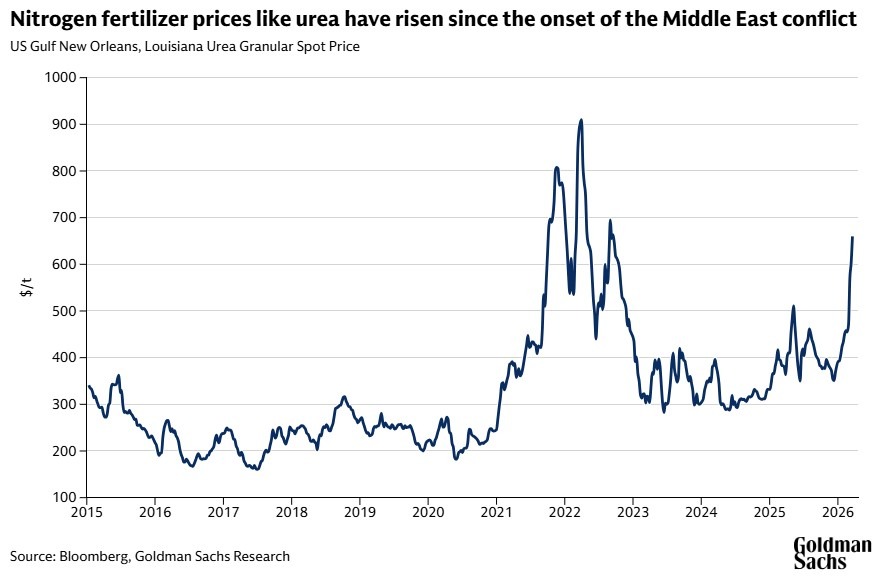
Without a resolution that reopens the Strait of Hormuz, there could be an economic double-whammy of higher energy prices and higher food prices, which could place upward pressure on inflation. In fact, investors just received the latest Consumer Price Index (CPI) report on April 10th which showed a 3.3% year-over-year increase in Headline CPI. This was largely influenced by a +10.9% increase in the energy index, which was led by a +21.2% increase in the index for gasoline.
Moving forward, according to inflation projections from the Cleveland Fed, CPI is expected to rise to nearly 3.6% for the month of April, as seen in the graph below.
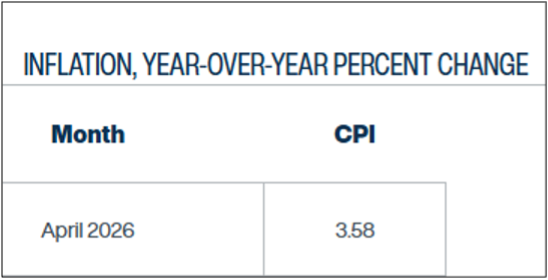
Source: Cleveland Fed – InflationNowcasting
Given the state of inflation, the labor market, and economic growth in the U.S., investors may begin to hear the dreaded ‘s-word’ referenced in the financial news media in the coming days and weeks. In the investing world, the dreaded ‘s-word’ is stagflation, which refers to a sustained period of elevated inflation, high unemployment, and low-to-negative growth. Personally, I think it’s a bit premature to be overly concerned about stagflation. At this stage, so much is still dependent on whether or not a resolution is reached that reopens the Strait of Hormuz. An agreement could be reached in a matter of days. If that’s the case, then energy prices could stabilize and fertilizer can reach farmers in time for peak planting seasons.
However, the longer this conflict persists, the greater the risk to the U.S. (and global) economy. As I indicated in last month’s investor letter, this is a fact of which politicians are well aware. With midterm elections on the horizon this fall, Republicans undoubtedly understand the challenges they might face at the polls if inflation continues to rise and if GDP growth stalls due to higher prices and an energy supply shock. Therefore, there’s ample motivation to reach a resolution that balances the economic and national security interests of the United States.
In the meantime, earnings season is set to begin during the week of April 13th. The Q1 2026 earnings growth rate for the S&P 500 is expected to be a very strong 12.6%. If this figure pans out, it would mark the sixth straight quarter of double digit earnings growth for the S&P 500 index. Furthermore, net profit margins are anticipated to remain robust at 13.2%. As an investor, this type of earnings growth potential keeps me excited about the U.S. stock market. It’s also worth noting that the S&P 500 has often exceeded earnings estimates in recent quarters, so I’ll be watching closely to see if that plays out once again.
I, for one, look forward to a time when investors can focus primarily on corporate and economic fundamentals, and less on geopolitics. Until then, we are well aware that this can be a disconcerting time for many investors, particularly when change is so rapid and we have many of our men & women in uniform in harm’s way. This is often a good time to ‘outsource’ some of that stress and disquiet to our team. If you are worried about the potential financial impact of a prolonged conflict in the Middle East, reach out to our team and we can model how various outcomes might impact your personal finances. If you would like me to address questions or concerns that haven’t been covered in an investor letter, I would encourage you to submit questions to our CIO Mailbag, and I’ll be sure to address your questions in a future post or have our team reach out to you directly. We’re here to simplify your life and if there’s anything we can do to assist to that end, please let us know. As always, as news changes and circumstances evolve, we’ll be sure to communicate our perspective with you in the days and weeks ahead.
Important note and disclosure: This article is intended to be informational in nature; it should not be used as the basis for investment decisions. You should seek the advice of an investment professional who understands your particular situation before making any decisions. Investments are subject to risks, including loss of principal. Past returns are not indicative of future results. Advisory services offered through Destiny Capital Corporation, an Investment Adviser registered with the U.S. Securities & Exchange Commission.
2024 YCharts, Inc. All Rights Reserved. YCharts, Inc. (“YCharts’) is not registered with the U.S. Securities and Exchange Commission (or with the securities regulatory authority or body of any state or any other jurisdiction) as an investment adviser, broker-dealer or in any other capacity, and does not purport to provide investment advice or make investment recommendations. This report has been generated using data manually input by the creator of this report combined with data and calculations from YCharts.com and is intended solely to assist you or your investment or other adviser(s) in conducting investment research. You should not construe this report as an offer to buy or sell, as a solicitation of an offer to buy or see, or as a recommendation to buy, sell, hold or trade, any security or other financial instrument. THE IMPORTANT DISCLOSURES FOUND AT THE END OF THIS REPORT (WHICH INCLUDE DEFINITIONS OF CERTAIN TERMS USED IN THIS REPORT) ARE AN INTEGRAL PART OF THIS REPORT AND MUST BE READ IN CONJUNCTION WITH YOUR REVIEW OF THIS REPORT. Disclosure – YCharts
Share this
Stay Ahead with Smart Investments
Learn how to invest wisely and minimize risks to protect your retirement savings.

Achieve Your Retirement Goals
Get personalized advice to meet your retirement goals. Book your call with Destiny Capital now.