Financial Advisor vs. CPA: Who Do You Need (and When) for a Remarkable Retirement?
If you’re approaching retirement, already retired, or building a business, you’ve probably wondered: “Do I need a financial advisor, a CPA, or both?”. Choosing the right professionals can create more clarity, confidence, and control over your money. In this guide, we’ll simplify the roles each plays and show you how they can work together as part of a coordinated plan.
Key Takeaways
- A CPA focuses on taxes, accounting, and compliance; a financial advisor focuses on your overall plan, investments, and long-term decisions.
- Retirees and pre-retirees often get the best results when their advisor and CPA collaborate on retirement income, Social Security, and tax planning.
- Business owners typically rely on a CPA for entity structure, bookkeeping, and tax strategy, while a financial advisor helps coordinate personal wealth, investments, and eventual exit planning.
- The right question is rarely “either/or” but “who should lead this decision, and how do we get them working together?”
What Does a CPA Actually Do?
A Certified Public Accountant (CPA) is a licensed accounting professional who specializes in keeping your financial life compliant with tax law and reporting rules. For most households and business owners, the CPA relationship centers on taxes, bookkeeping, and financial statements.
Common ways a CPA helps:
- Preparing and filing individual and business tax returns.
- Designing tax strategies to help reduce what you owe over time within current law.
- Advising business entity choice (LLC, S-Corp, partnership) and how profits are taxed.
- Creating and reviewing financial statements, and in some cases representing you before the IRS.
For a retiree, that might look like modeling the tax impact of required minimum distributions (RMDs) and Roth conversions in a specific year. For a business owner, it could mean structuring payroll, deductions, and depreciation in a tax-aware way, so you keep more of what you earn.
What Does a Financial Advisor Do?
A financial advisor focuses on your overall financial strategy—how all the pieces of your life and money work together over years and decades. At Destiny Capital, that means using a Personal Wealth Operating System™ (PWOS™) to structure, simplify, and strategically manage your wealth so you can pursue a Remarkable Retirement.
Key areas where a financial advisor can help:
- Retirement planning: When can you retire, how much can you spend, and how do you turn savings into steady income?
- Investment management: Building and maintaining a diversified, risk-managed portfolio aligned with your goals and timeline.
- Tax-aware withdrawal strategy: Coordinating which accounts you tap (taxable, tax-deferred, Roth) and when.
- Insurance, estate, and legacy planning: Making sure your plan protects the people and causes you care about.
For entrepreneurs and business owners, a financial advisor also helps connect your business decisions to your personal plan, so cash flow, equity value, and eventual exit planning support your long-term lifestyle, not just next quarter’s numbers.
Financial Advisor vs. CPA: How Their Roles Differ
Here’s a simple way to see the main differences:
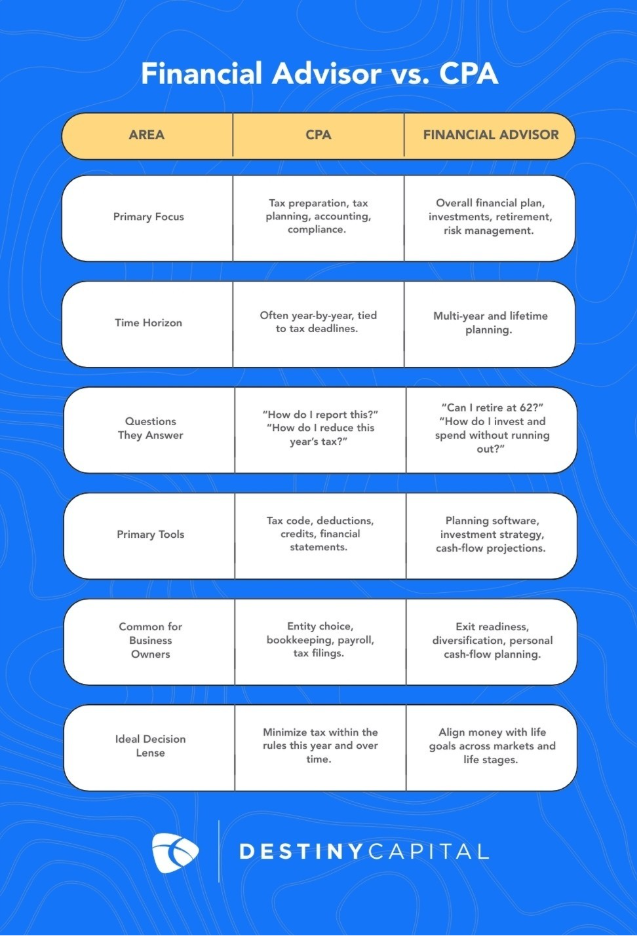
Both are highly trained and valuable; they simply sit at different points in your financial life. A CPA usually looks at what has happened and how to report it correctly, while a financial advisor spends more time on where you’re going and how to get there with less guesswork.
When Retirees and Pre-Retirees Need a CPA, an Advisor, or Both
If you’re in or nearing retirement, you’re juggling questions about income, taxes, and risk at the same time. This is exactly where a CPA and financial advisor can complement one another.
Situations where a CPA is especially important:
- Your tax return has become complex (multiple accounts, rental properties, business interests).
- You’re considering large Roth conversions or charitable gifts and want to understand the tax impact in detail.
- You receive K-1s, have significant realized capital gains, or face unique state tax issues.
Situations where a financial advisor is essential:
- You want to know when you can retire and how much you can safely spend each year.
- You need a plan to coordinate Social Security, pensions, investment accounts, and healthcare costs over decades.
- You worry about outliving your savings or making a major mistake with market risk.
Where both should work together:
- Designing a tax-aware retirement income strategy (which accounts to draw from first and how much).
- Evaluating Roth conversions over a multi-year window, not just one tax year.
- Planning for required minimum distributions and potential impact on Medicare premiums.
For example: Your CPA may show that a partial Roth conversion this year keeps you in a favorable tax bracket, while your financial advisor models how that decision affects your long-term income, portfolio, and estate goals.
When Business Owners Need a CPA, a Financial Advisor, or Both
Business owners and entrepreneurs often need both roles, and need them to talk to each other. Your business and personal finances are usually tightly linked.
Where a CPA is indispensable for business owners:
- Helping choose and maintain the right entity structure (LLC, S-Corp, etc.).
- Handling tax filings, payroll, and compliance for your company.
- Advising on deductions, depreciation, and how to manage taxable income year by year.
Where a financial advisor adds significant value:
- Translating volatile business cash flow into a stable personal plan for your family.
- Coordinating retirement savings outside the business (IRAs, 401(k)s, taxable investments).
- Planning for a future exit: how much you need from a sale, how to invest proceeds, and how to reduce concentration risk in your net worth.
Often, your CPA might recommend a particular way to structure a sale or bonus; your advisor then determines how to invest those proceeds and integrate them into your long-term Personal Wealth Operating System™ so you stay on track for your version of a Remarkable Retirement.
How Destiny Capital Works With CPAs
You shouldn’t have to play “go-between” between your advisor and your CPA. At Destiny Capital, our role is to act as your coordinated wealth partner and to collaborate directly with your tax professional when you invite us to.
That collaboration can include:
- Sharing your retirement income plan, portfolio strategy, and upcoming large transactions with your CPA so they can anticipate tax impacts.
- Requesting and reviewing tax returns to identify opportunities for future-year tax planning (bracket management, capital gains, charitable giving).
- Aligning recommendations so you aren’t getting conflicting advice or leaving money on the table through missed opportunities.
- For many of our Denver and Golden clients, this teamwork is part of their Personal Wealth Operating System™: a structured way to keep cash flow, investments, and taxes working together proactively, instead of reacting once a year at tax time.
How To Decide Who to Call First
If you’re not sure where to start, use this simple rule of thumb:
Start with a CPA if your main question is “How do I report this, or reduce my tax bill this year?”
Start with a financial advisor if your main question is “Am I on track, and how do I use my money wisely over the next 10–30 years?”
In practice, most retirees, pre-retirees, and business owners benefit from having both on their financial team and letting each do what they do best. When these professionals collaborate, you’re more likely to enjoy the clarity of a long-term roadmap and the confidence that the tax details are handled correctly along the way.
If you’d like help coordinating your financial life with the right tax expertise, Destiny Capital can help you build a Personal Wealth Operating System™ tailored to your retirement or business goals. Talk with our team to see if we’re a good fit.
This material is for informational purposes only and should not be considered investment or tax advice. Investing involves risk, including loss of principal. Past performance is not indicative of future results. Consult professionals who understand your situation before making decisions.
Share this
Stay Ahead with Smart Investments
Learn how to invest wisely and minimize risks to protect your retirement savings.

Achieve Your Retirement Goals
Get personalized advice to meet your retirement goals. Book your call with Destiny Capital now.