Markets and Economy – Visibility is Limited
by Tim Doyle, Chief Investment Officer, CFP®, MBA
A few weeks ago, folks where I live here on the east coast started talking about a hurricane named ‘Melissa’ that was building-up steam in the Caribbean. “Experts are saying by the time it hits the northeast, it could be another Superstorm Sandy,” a handful of people told me with trepidation. The 2012 storm was devastating for people in the tri-state (NY, NJ, CT) area, so nerves quickly become frayed whenever the name “Sandy” is mentioned, and I immediately began to regret never getting a generator installed at my home.
While Hurricane Melissa left tragic destruction across Jamaica, Cuba and more, a Sandy-like storm never quite emerged over the east coast. However, we did get rain – lots and lots of rain. Each school day, I typically pick up my two boys from after-care, and I happened to grab my youngest son and get back on the road right when a particularly fierce squall hit our area and rain showered down in buckets. My SUV’s windshield wipers couldn’t keep up with the sudden deluge, so I flipped on my hazard lights and slowed my vehicle to a crawl. When visibility is limited like that, it definitely pays to be cautious. It’s not the time for quick lane changes or exploring a new route home.
As an investor, I’ve had a very similar mindset over the past month given that – despite a temporary funding bill passed by the Senate – the U.S. government is in the midst of its single longest shutdown in history. Much like when I was caught in that rain squall, visibility has been limited because investors do not have access to key government data that we’re reliant on to give us insight into inflation, the job market, the housing market, retail sales, and more.
When Fed Chairman, Jerome Powell, addressed the media after the latest Fed meeting on October 30th, he stated that the Federal Open Market Committee (FOMC) was in a similar predicament. With so much economic data either missing or delayed, the Fed has been largely reliant on private market data and anecdotal reports. Yes, as expected, the Fed cut the federal funds rate by 0.25% on October 29th. However, Powell stressed that additional rate cuts are “far from a foregone conclusion” in the minds of the FOMC.
This comment sent some shockwaves across financial markets given that investors had been pricing-in over a 90% probability of an additional rate cut in December. As we all know by now, when the Fed deviates from investor expectations, market volatility tends to follow soon after, and that’s exactly what we’ve seen happen in recent weeks. The chart below illustrates the recent drawdown experienced in both the S&P 500 and Nasdaq 100 indexes immediately after the Fed meeting in late October. As you can see, as-of this writing, both the S&P 500 and Nasdaq 100 were down roughly 2.5% and -3.75% since Chairman Powell’s press conference.

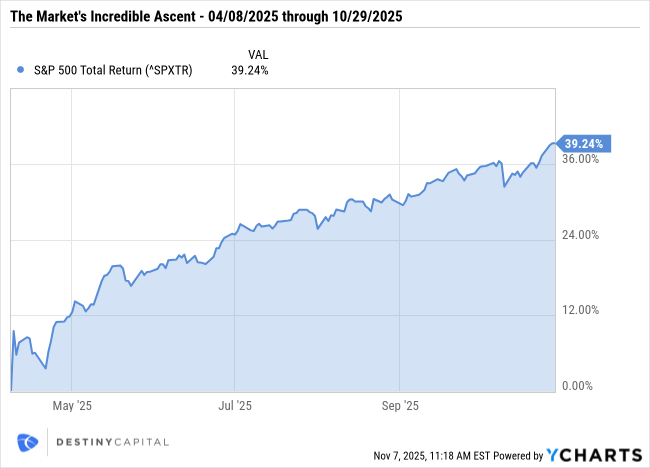
While watching stocks lose ground is never fun, it’s also important to note that the S&P 500 had been on a torrid ascent ever since the Trump administration walked back some of the steep tariffs announced on ‘Liberation Day’ in early April. In fact, since the market lows on April 8th, the S&P 500 Index climbed a staggering 39% in just a few short months, as seen below.
While some uncertainty may begin to creep into investor subconscious, it’s important to note that we are well-over halfway through Q3 2025 earnings season, and earnings have been quite strong. With over 65% of S&P 500 companies reporting to-date, 83% have beaten earnings estimates, while 79% have beaten revenue estimates, according to FactSet. Both of these figures are well above the 5 and 10-year averages.
Perhaps one of the most compelling stories for investors has been that of the earnings growth rate of the S&P 500 overall. Earnings growth is one of the key drivers of shareholder value and essentially represents the increase in a company’s net profit over a specified period. Prior to Q3 2025 earnings season, analysts were predicting a solid year-over-year earnings growth rate for the S&P 500 of +7.9%. However, as-of this writing, the earnings growth rate of the S&P 500 stands at +10.7%. If this number holds, it will represent the fourth consecutive quarter of double-digit earnings growth for the S&P 500 index overall.
Furthermore, according to FactSet, analysts are projecting strong earnings growth in the quarters ahead, as you can see in the chart below. While earnings growth is predicted to dip slightly in Q4 of 2025, it is expected to accelerate again in 2026 with an estimated year-over-year growth rate of +11.8% in Q1 2026, +12.8% in Q2 2026, and +14.8% in Q3 of 2026, as highlighted in red below.

While these estimates are certainly encouraging for investors, it’s important to keep in mind that these are only projections and, in some ways, Q3 of 2026 feels like a lifetime away considering what is happening in the here-and-now. For example, while we’ve seen some progress in ending the shutdown in the Senate, a vote still needs to take place in Congress.
For many of us who are scheduled to travel by air both now and around the Thanksgiving holiday, I certainly hope that a resolution is expeditious so travelers can avoid delays and cancellations due to the air traffic controller and TSA shortages. Then again, inconveniences related to air travel pale in comparison to government workers who have been furloughed or are working without pay, for families that rely on SNAP to help put food on the table, and so forth. While the shutdown hasn’t significantly impacted financial markets yet, that could change if Congress fails to pass the stopgap funding measure, and the shutdown extends in perpetuity.
Furthermore, with the government shutdown and recent elections sucking up much of the oxygen in the room, investors may have missed the fact that the Trump administration recently defended its current trade policies in front of the U.S. Supreme Court. From the viewpoint of investors, the outcome of this case could have a substantial economic impact, particularly if the Supreme Court rules against the Trump administration and they find the use of tariffs as unlawful.
In oral arguments, the petitioner’s counsel (the Trump admin legal team) stated the President has broad authority under the International Emergency Economic Powers Act (IEEPA) to act during emergencies that impact national security. The administration argues that the use of tariffs falls under these emergency powers. Among other things, the respondent’s counsel (the legal team arguing on behalf of various businesses) argued that tariffs represent a tax, and taxation falls under the purview of Congress under Article I of the U.S. constitution.
If this were a standard Supreme Court case, we might expect to see a ruling around the summer of 2026. However, given the significant economic importance of this case, a ruling may come earlier with some pundits suggesting December of 2025, while most others are speculating that March of 2026 is a more realistic timeframe. Regardless, tariffs were a shockwave that sent ripples across the global economy, so this is a case that investors should be following closely.
To close, in recent weeks, we’ve seen an uptick in stock market volatility. After a relatively calm summer, we’ve seen volatility begin to heat up just as the weather outside continues to cool down, as you can see in the chart below that shows the CBOE S&P 500 Volatility Index (VIX).

As a reminder, we consider any VIX reading at-or-above 20 to be ‘volatile’ and, at these levels, investors should expect wilder swings in market performance from one day to the next. However, it’s important to stress that volatility and short-term market selloffs are completely normal. In fact, the linear +39% market ascent referenced earlier in this letter is the exception, not the rule. As investors, we’ve been fortunate to experience roughly three years of solid market performance, and short-term volatility is often the price of admission for long-term growth.
However, I want to stress that if you ever have any questions or concerns about your investment portfolio and how short-term volatility might impact your financial future, please don’t hesitate to reach out to our team. This often is when comprehensive financial planning provides the most value by offering peace of mind to investors during times of stress. Our team is busy executing year-end initiatives around tax planning and more, but we’re never too busy for a client in need. In the meantime, while it’s hard to believe that Turkey Day is right around the corner. As someone who loves to cook and host, this is always one of my favorite times of the year, so, I want to wish you all a Happy Thanksgiving and hope you get to enjoy some special time with friends and family in the weeks ahead. While it’s been a turbulent ride at times this year, investors can be thankful for another solid year of stock market returns along with a welcome resurgence in bond markets.
Important note and disclosure: This article is intended to be informational in nature; it should not be used as the basis for investment decisions. You should seek the advice of an investment professional who understands your particular situation before making any decisions. Investments are subject to risks, including loss of principal. Past returns are not indicative of future results. Advisory services offered through Destiny Capital Corporation, an Investment Adviser registered with the U.S. Securities & Exchange Commission.
2024 YCharts, Inc. All Rights Reserved. YCharts, Inc. (“YCharts’) is not registered with the U.S. Securities and Exchange Commission (or with the securities regulatory authority or body of any state or any other jurisdiction) as an investment adviser, broker-dealer or in any other capacity, and does not purport to provide investment advice or make investment recommendations. This report has been generated using data manually input by the creator of this report combined with data and calculations from YCharts.com and is intended solely to assist you or your investment or other adviser(s) in conducting investment research. You should not construe this report as an offer to buy or sell, as a solicitation of an offer to buy or see, or as a recommendation to buy, sell, hold or trade, any security or other financial instrument. THE IMPORTANT DISCLOSURES FOUND AT THE END OF THIS REPORT (WHICH INCLUDE DEFINITIONS OF CERTAIN TERMS USED IN THIS REPORT) ARE AN INTEGRAL PART OF THIS REPORT AND MUST BE READ IN CONJUNCTION WITH YOUR REVIEW OF THIS REPORT. Disclosure – YCharts
Share this
Stay Ahead with Smart Investments
Learn how to invest wisely and minimize risks to protect your retirement savings.

Achieve Your Retirement Goals
Get personalized advice to meet your retirement goals. Book your call with Destiny Capital now.