CIO Mailbag: How will A.I. impact the U.S. Labor Market?
by Tim Doyle, Chief Investment Officer, CFP®, MBA
Back in November of 2023, businesses and investors became enthralled with the concept of artificial intelligence (AI) as OpenAI launched their groundbreaking large language model (LLM) chatbot ChatGPT. This tool gave the average person a glimpse into the exciting potential of artificial intelligence and began an AI “arms race”, of sorts, as hyperscalers like Amazon, Meta, Alphabet, Microsoft and others invested hundreds of billions of dollars into AI infrastructure, research, and development.
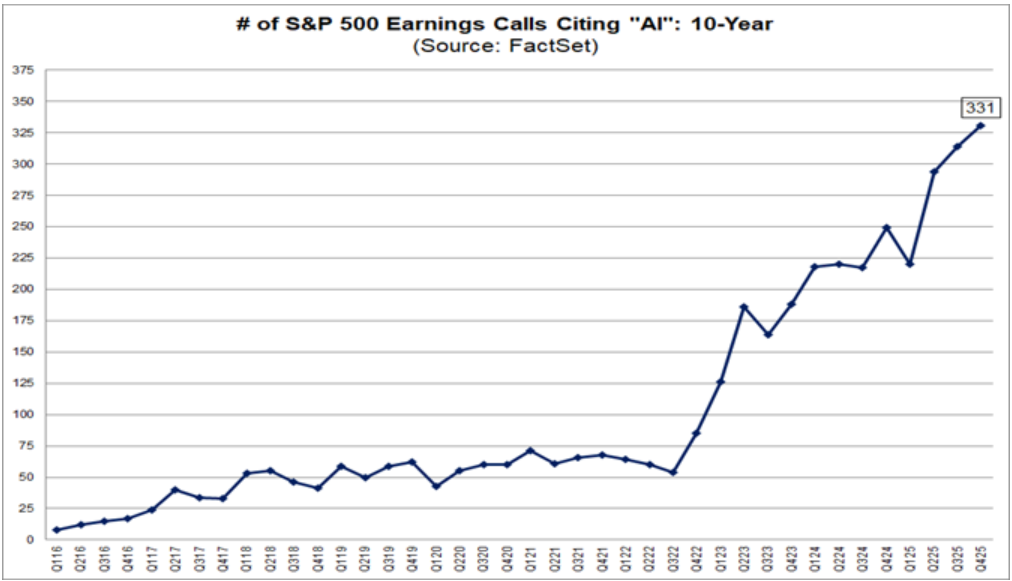
At this stage, many corporations now seem akin to air travelers on a busy holiday weekend. With heads down, they are buying tickets, racing through the terminal, and showing up at the gate for a flight where the final destination remains unclear. Despite this uncertainty, the focus on AI is acute and talk of artificial intelligence remains ubiquitous in C-Suites across the country as you can see in the chart below that shows the number of S&P 500 earnings calls where ‘AI’ was cited in Q4 of 2025.
In recent quarters, we’ve come to learn that there’s a good reason for some of this hype. For several years, many corporate users have been utilizing chatbots like ChatGPT, Claude, Grok, Gemini, Copilot and others as an ‘enhanced Google search’, for lack of a better term. Yes, these tools can be helpful and insightful, but not necessarily transformative. However, that’s quickly changing as more corporations are leaning into ‘Agentic AI’.
While AI chatbots can collaborate with users and provide useful information, AI Agents can reason, plan workflows and execute actions with limited supervision. Ultimately, agents are designed to be a ‘general-purpose digital worker’. As a very simplistic example, there are many jobs across the economy with projects that require tedious, administrative tasks that must be executed in order to complete the project. The administrative steps in these processes could take hours. With Agentic AI, a user can train the AI on each step in the process (using plain language) and save it as a repeatable workflow. Once saved, an employee can then prompt the Agent to complete this task and go from prompt to review/approve/execute in a matter of minutes instead of taking hours of ‘task time’ prior to completion. All of this is done without needing to generate a single line of code.
At first glance, saving an employee from a few hours of ‘tasky’ admin work might seem somewhat inconsequential. However, multiply these hours saved across a variety of tasks, roles, teams, departments and organizations, and we’re talking about the potential for tremendous productivity gains. Furthermore, AI Agents are increasingly able to do more and more work that requires complex analysis, reasoning, and execution, not just admin work. This is what gets C-Suite executives so excited because, with enhanced productivity, organizations may be able to increase revenues with the same (or lower) employee headcount. This, in turn, could enhance corporate profitability, which is a wonderful thing from an investor perspective.
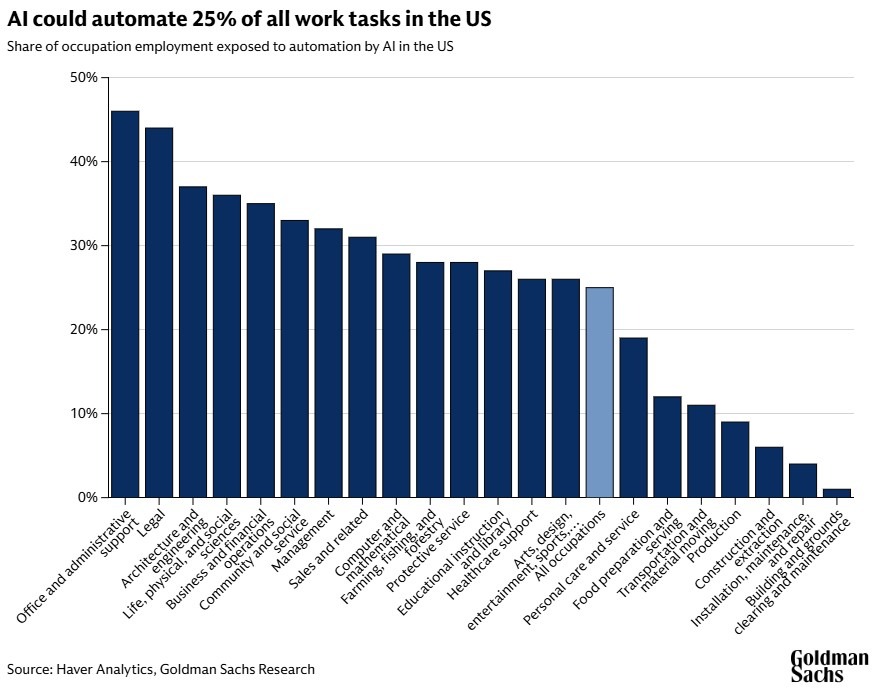
However, what might be music to the ears of a CEO could cause tremendous anxiety for workers. According to research by Goldman Sachs, they estimate that AI could automate roughly 25% of all work tasks in the United States, as seen in the chart below that shows the share of occupation employment exposed to AI automation.
Having said that, the U.S. economy is not immune to broader movements in commodity markets, and the war with Iran and the subsequent closure of the Strait of Hormuz is causing a short-term supply shock that has caused the price of oil to skyrocket above $92 per barrel as-of this writing.
On the other hand, another recent study by MIT estimates that AI automation can perform about 14% of occupational tasks in the United States. MIT uses an iceberg analogy to describe the potential impact of AI, with the most visible impact being felt in coastal tech hubs as AI impacts software development and data science. Meanwhile, a larger impact remains somewhat hidden with AI’s impact on cognitive work like HR, Customer Support, Finance and more. This impact will be more broadly felt across the 50 states.
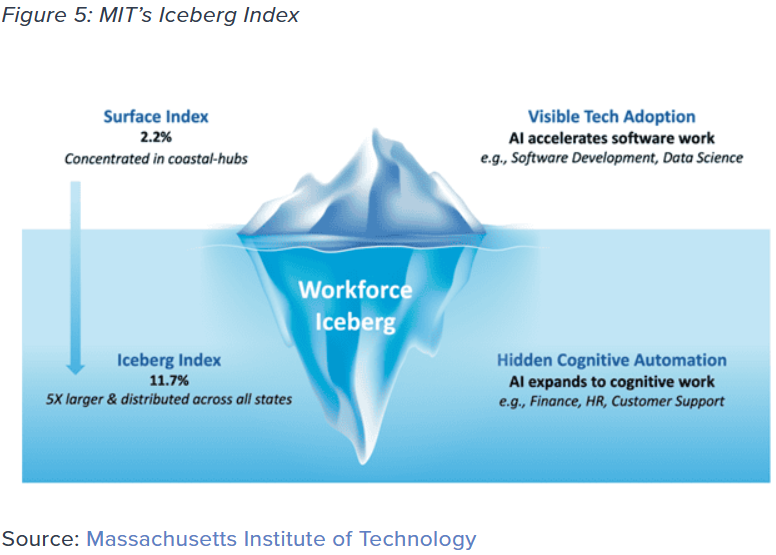
Regardless of whether or not AI impacts twenty-five or fourteen percent of occupational tasks, the potential for disruption is real. In fact, according to the aforementioned research report by Goldman Sachs, about 300 million jobs across the globe are exposed to AI automation in some way. To be clear, this isn’t insinuating that 300 million jobs will be replaced by AI, but research suggests that these jobs will be impacted in the years ahead.
Focus then shifts to timeline and the nature of the impact. The general timeframe for firms to adopt AI on a considerable scale is estimated to be roughly 10 years, and Goldman Sachs estimates that roughly 6%-7% of workers will be displaced during that period. If displacements are spread out over time, that could equate to a 0.6% increase to the unemployment rate. However, if adoption is front-loaded and sudden, then the impact could be more pronounced in the near term.
Ultimately, research suggests that we aren’t headed towards a future of mass joblessness. For the majority of workers, AI will likely be utilized as a complement, not a replacement. Personally, when I think about how I might utilize generative AI to improve in my role and generate better outcomes for Destiny Capital investors, I get very excited. It’s also expected that AI adoption will generate many new jobs, as well, with an immediate focus on construction, engineering, and skilled trades as AI infrastructure (data center) buildout remains in focus.
However, we are entering a transitional period for some in the labor force and, without thoughtful execution, this transition could become unequal and polarizing. Therefore, this transition may require investments in education & reskilling, labor standards & workplace AI rules, tax incentives for human worker retention, worker safety nets & transitional income support, and more. If the transition is poorly handled, we could potentially see some pushback on AI technology as consumers and even investors may prefer ‘human-centric’ organizations. We are seeing small examples of this dynamic with radio stations under the iHeartMedia umbrella that claim “Guaranteed Human” during broadcasts to ensure listeners that content isn’t purely AI generated.
It’s important to remember that the economy has navigated many transformational innovations in the past that have generated lasting economic value. Examples might be the railroad boom of the 1860’s, the electrification of the American industrial complex in the early 20th century, the proliferation of the personal computer & the advent of the internet in the late 1990s.
Like the innovations detailed above, the adoption of generative AI is bound to have a significant and lasting impact on the global economy. It is up to us to help dictate the nature and scale of that impact. While corporations are incentivized by profits, they are also keenly aware of the importance of a healthy U.S. labor market. When jobs are plentiful and unemployment is low, Americans tend to spend. Given that roughly 2/3rds of U.S. GDP is derived from consumption, a strong labor market is vital. Therefore, it will be crucial for corporate and governmental leaders to balance these incentives in the quarters ahead to effectively navigate this transition so the benefits of AI are broadly felt across the U.S. economy.
Important note and disclosure: This article is intended to be informational in nature; it should not be used as the basis for investment decisions. You should seek the advice of an investment professional who understands your particular situation before making any decisions. Investments are subject to risks, including loss of principal. Past returns are not indicative of future results. Advisory services offered through Destiny Capital Corporation, an Investment Adviser registered with the U.S. Securities & Exchange Commission.2024 YCharts, Inc. All Rights Reserved. YCharts, Inc. (“YCharts’) is not registered with the U.S. Securities and Exchange Commission (or with the securities regulatory authority or body of any state or any other jurisdiction) as an investment adviser, broker-dealer or in any other capacity, and does not purport to provide investment advice or make investment recommendations. This report has been generated using data manually input by the creator of this report combined with data and calculations from YCharts.com and is intended solely to assist you or your investment or other adviser(s) in conducting investment research. You should not construe this report as an offer to buy or sell, as a solicitation of an offer to buy or see, or as a recommendation to buy, sell, hold or trade, any security or other financial instrument. THE IMPORTANT DISCLOSURES FOUND AT THE END OF THIS REPORT (WHICH INCLUDE DEFINITIONS OF CERTAIN TERMS USED IN THIS REPORT) ARE AN INTEGRAL PART OF THIS REPORT AND MUST BE READ IN CONJUNCTION WITH YOUR REVIEW OF THIS REPORT. Disclosure – YCharts
Share this
Stay Ahead with Smart Investments
Learn how to invest wisely and minimize risks to protect your retirement savings.

Achieve Your Retirement Goals
Get personalized advice to meet your retirement goals. Book your call with Destiny Capital now.